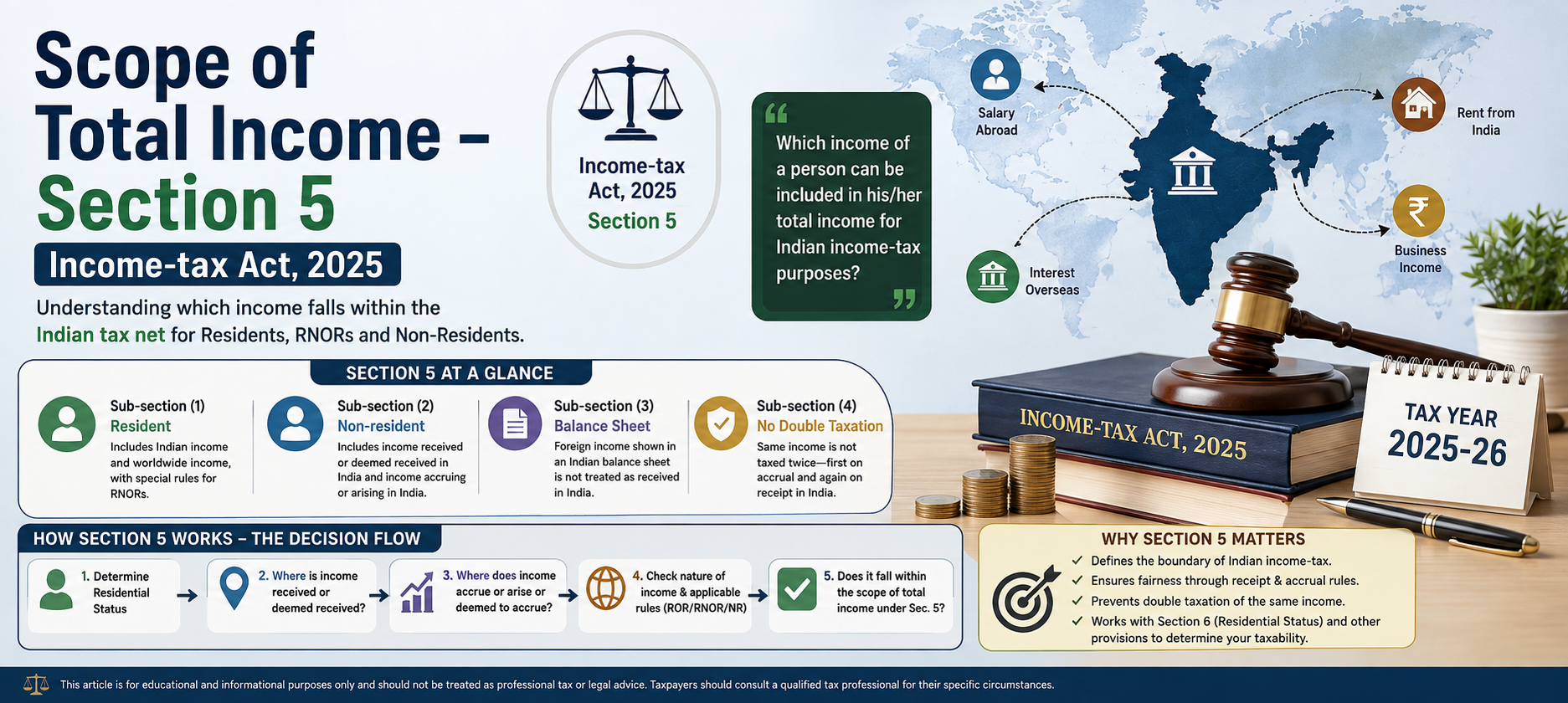
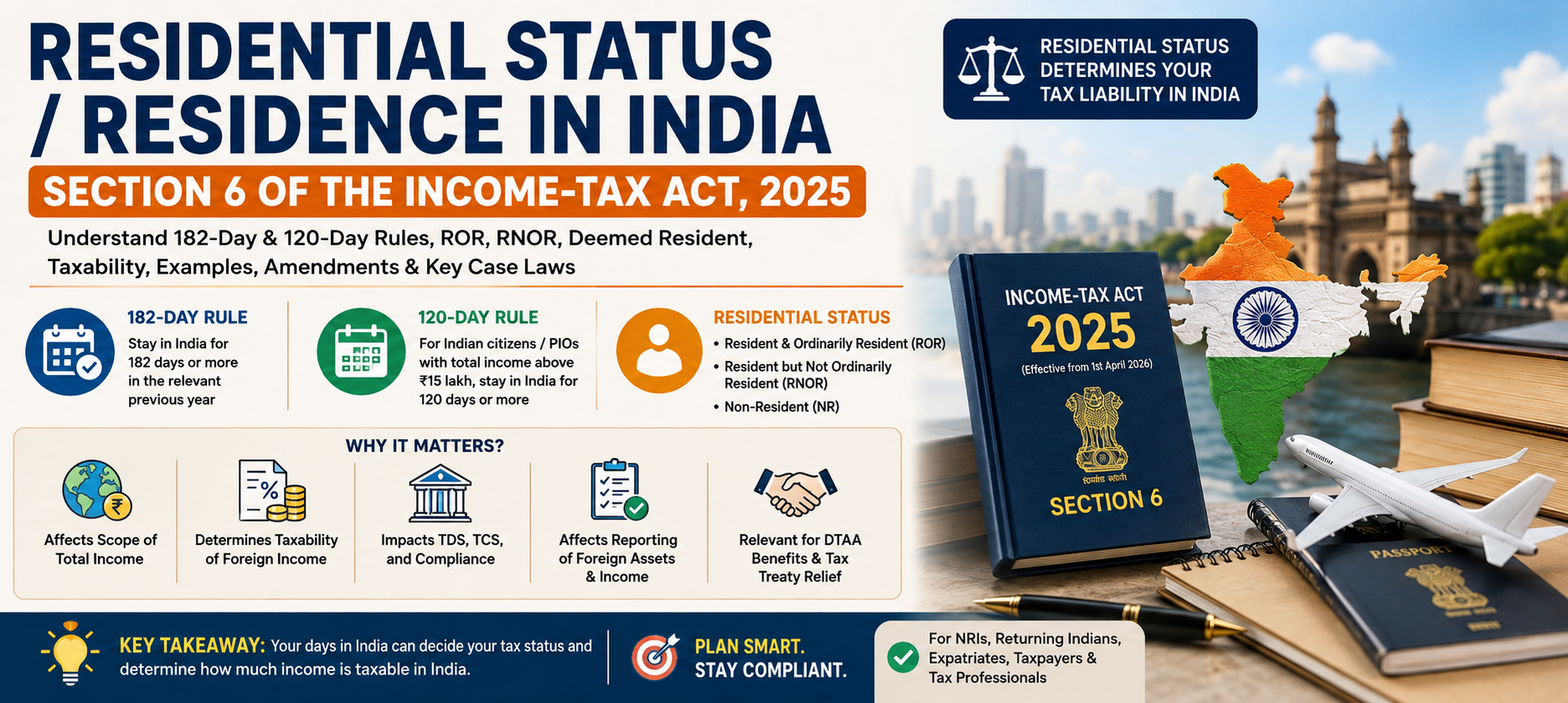
The Income-tax Act, 2025 (“Income-tax Act, 2025” or “new Act”) came into force on 1 April 2026 and replaced the Income-tax Act, 1961 (“old Act”) for tax years beginning on or after that date.
For Tax Year 2026–27 onwards, residential status is determined under Section 6 of the Income-tax Act, 2025.
Importantly, the new Act has not materially changed the fundamental individual residential-status tests. The familiar 182-day rule, 60 days + 365 days rule, 120-day rule for certain high-income Indian citizens/Persons of Indian Origin (PIOs), deemed-resident rule and RNOR tests have substantially been carried forward, although the section numbering and terminology have changed.
For earlier tax years, the Income-tax Act, 1961 continues to apply. In other words, the fact that an assessment or reassessment is carried out after 1 April 2026 does not by itself move an earlier tax year into the new Act.
What is Residential Status under Income-tax Law?
Residential status determines how much of a person’s income can be brought within the Indian income-tax net.
It is important to understand that residential status is not the same thing as citizenship.
A person may be:
- an Indian citizen but a non-resident for Indian income-tax purposes;
- an Indian citizen and an income-tax resident;
- a foreign citizen but an income-tax resident of India;
- a resident under the Income-tax Act but resident outside India under FEMA; or
- resident in two countries under their domestic laws but treated as resident of only one country under a Double Taxation Avoidance Agreement (DTAA).
Therefore, residential status must be determined separately for each tax year.
For individuals and Hindu Undivided Families (HUFs), the law further distinguishes between:
1. Resident and Ordinarily Resident (ROR)
2. Resident but Not Ordinarily Resident (RNOR)
3. Non-Resident (NR)
The distinction is extremely important because it can determine whether foreign income is taxable in India.
The Income Tax Department itself describes residential status as a key factor affecting the scope of income taxable in India.
Section 6 — Residence in India under the Income-tax Act, 2025
Section 6 of the Income-tax Act, 2025 is titled “Residence in India.”
For individuals, the basic rule is straightforward:
An individual becomes a resident in India if either:
- he or she stays in India for 182 days or more during the tax year; or
- he or she stays in India for 60 days or more during the tax year and has stayed in India for 365 days or more during the four preceding tax years.
These are the basic tests under Section 6(2).
The two basic tests:
| Test | Current rule |
|---|---|
| 182-day test | Stay in India for 182 days or more during the tax year |
| 60 + 365 test | Stay in India for 60 days or more during the tax year and 365 days or more during the preceding 4 tax years |
Satisfying either test is enough to become a resident, subject to the special rules for Indian citizens, PIOs and certain other categories.
The 182-Day Rule Explained
The 182-day test is the easiest residential-status test.
If an individual is physically present in India for 182 days or more during the relevant tax year, the individual is generally resident in India.
Example
Suppose Vinod lives in Dubai but spends:
- 1 April 2026 to 30 September 2026: 183 days in India.
Since his stay is at least 182 days, he satisfies the basic residence test.
Therefore, he is resident in India for Tax Year 2026–27, subject to classification as ROR or RNOR.
Is 182 days mandatory?
No.
This is one of the most common misunderstandings about Indian tax residency.
A person can become resident even with fewer than 182 days in India if the applicable 60 days + 365 days test is satisfied.
For some Indian citizens and PIOs visiting India, the threshold is modified to 120 days where the specified income condition is satisfied.
The 60-Day + 365-Day Rule
Under the general rule, an individual becomes resident if:
- the person stays in India for at least 60 days during the relevant tax year; and
- the person has stayed in India for at least 365 days during the four preceding tax years.
Example
Rahul stays in India for:
- 75 days during Tax Year 2026–27; and
- 410 days during the four preceding tax years.
He satisfies both conditions.
Therefore, he becomes a resident, even though he has not stayed in India for 182 days.
Why the 120-Day Rule Matters
The 120-day rule is particularly important for NRIs and PIOs who visit India.
Section 6(4) provides a special relaxation for an individual who:
- is an Indian citizen or Person of Indian Origin (PIO); and
- is outside India and comes to India on a visit.
For such a visitor, the ordinary 60-day test does not apply.
However, if the person’s total income, excluding income from foreign sources, exceeds ₹15 lakh, Section 6(5) substitutes 120 days for 60 days.
Thus, for the specified high-income visitor:
120 days in India + 365 days in the preceding four tax years = resident
subject to the statutory conditions.
119 Days vs 120 Days
This difference can be extremely important.
Example 1 – 119 days
An Indian citizen living in Singapore:
- stays in India for 119 days;
- has Indian income of ₹20 lakh;
- has stayed in India for 400 days during the preceding four tax years.
The person does not satisfy the 120-day condition.
Assuming no other residence/deemed-residence rule applies, the person remains Non-Resident.
Example 2 – 120 days
Now assume the same person stays in India for 120 days.
He satisfies:
- 120 days in the current tax year; and
- 365+ days during the preceding four years.
He therefore becomes Resident under the special visitor rule.
However, he will generally be RNOR, rather than ROR, because Section 6(13) specifically covers an Indian citizen/PIO visitor with income above ₹15 lakh who stays at least 120 but less than 182 days.
This is why one additional day can potentially change the tax result.
Special Rule for Indian Citizens Leaving India for Employment
The law gives special protection to an Indian citizen who leaves India:
- for employment outside India; or
- as a crew member of an Indian ship.
For such an individual, the normal 60-day condition under Section 6(2)(b) does not apply.
Instead, the person is generally tested using the 182-day threshold for that departure year.
Example
Amit leaves India on 15 September 2026 to take up employment in Canada.
His stay in India during Tax Year 2026–27 is 168 days.
Because he left India for employment outside India, the special rule applies. The 60-day + 365-day test is not used in the ordinary manner.
Since his Indian stay is below 182 days, he may remain Non-Resident, assuming no deemed-residence provision applies.
Indian Ship Crew Members
Section 6 also contains a special rule for an Indian citizen who leaves India as a member of the crew of an Indian ship.
The number of days in India relating to the relevant foreign-bound voyage is to be determined in the prescribed manner.
This is particularly relevant for:
- merchant navy personnel;
- shipping professionals; and
- Indian citizens working as crew on foreign-bound vessels.
The Income Tax Department confirms that the special 182-day relaxation continues under the new Act.
Special Rule for Indian Citizens and PIOs Visiting India
An Indian citizen or PIO who lives outside India and visits India receives a special relaxation.
If income excluding foreign-source income does not exceed ₹15 lakh
The normal 60-day condition is replaced by 182 days.
Thus, the person generally becomes resident only if:
- stay in India is 182 days or more; and
- the relevant conditions of the law are satisfied.
If income excluding foreign-source income exceeds ₹15 lakh
The threshold becomes 120 days instead of 60 days.
Therefore:
120 days + 365 days in preceding four years = possible residence
This is one of the most important rules for high-income NRIs visiting India.
What Does “₹15 Lakh” Mean?
The ₹15 lakh threshold is not simply “all foreign and Indian income.”
Section 6 uses the concept of income from foreign sources.
Section 6(14) defines income from foreign sources broadly as income accruing or arising outside India, except income derived from:
- a business controlled in India; or
- a profession set up in India,
and income which is deemed to accrue or arise in India.
This distinction can be crucial.
Example
An Indian citizen living abroad has:
- foreign salary: ₹30 lakh;
- Indian rental income: ₹10 lakh.
The foreign salary may qualify as foreign-source income, subject to the statutory definition.
The Indian rental income is not foreign-source income.
Therefore, the ₹15 lakh test cannot be understood merely by looking at the person’s total global income.
Deemed Resident — Section 6(7)
The Income-tax Act, 2025 retains the deemed-residence rule.
An individual is deemed to be resident in India if:
- he is an Indian citizen;
- he is not liable to tax in any other country or territory because of domicile, residence or similar criteria; and
- his total income, other than income from foreign sources, exceeds ₹15 lakh.
This is Section 6(7).
Why is this important?
The person may not satisfy the normal day-count tests.
The number of days spent in India may therefore become irrelevant if the deemed-residence conditions are independently satisfied.
Example
An Indian citizen lives in a low-tax jurisdiction but is not liable to tax there because he does not meet that country’s tax-residence criteria.
He earns:
- Indian-source income: ₹18 lakh;
- foreign-source income: ₹50 lakh.
If the statutory conditions are met, he can be deemed resident in India despite spending very few days in India.
However, such a deemed resident is classified as RNOR, not ROR, under Section 6(13).
Deemed Resident Is Not the Same as ROR
This is an important point.
A person who is deemed resident under Section 6(7) is specifically brought within the RNOR category under Section 6(13).
Therefore:
Deemed Resident → RNOR
and not automatically:
Deemed Resident → ROR
This distinction significantly affects the taxation of foreign income.
Resident but Not Ordinarily Resident (RNOR)
Being resident in India does not automatically mean that the person is ROR.
The next question is:
Is the person Resident and Ordinarily Resident (ROR) or Resident but Not Ordinarily Resident (RNOR)?
Section 6(13) contains the RNOR rules.
An individual is generally RNOR if either:
- he has been non-resident in India in 9 out of the 10 preceding tax years; or
- he has been in India for 729 days or less during the 7 preceding tax years.
The word “or” is important.
The two tests are alternative tests, not cumulative tests.
RNOR Test 1 — Non-Resident in 9 out of 10 years
Suppose a person becomes resident in Tax Year 2026–27.
Looking back over the preceding ten tax years:
- he was NR in 9 years; and
- resident in only 1 year.
He qualifies as RNOR.
RNOR Test 2 — 729 Days or Less
Alternatively, an individual may be RNOR if his total stay in India during the preceding seven tax years is 729 days or less.
The practical significance is that a returning NRI can often enjoy RNOR status for some time after becoming resident.
Special RNOR Rule for High-Income Indian Citizens/PIOs
Section 6(13) also covers an Indian citizen or PIO who:
- has income excluding foreign-source income exceeding ₹15 lakh;
- stays in India for 120 days or more but less than 182 days; and
- qualifies under the relevant visiting-person rule.
Such a person is treated as RNOR.
This means the 120-day rule does not simply turn an NRI into a full-fledged ROR.
Instead, the legislation provides a special intermediate status.
ROR — Resident and Ordinarily Resident
A person who is resident but does not satisfy any of the RNOR conditions becomes ROR.
In simplified terms:
Resident + none of the RNOR conditions = ROR
ROR is the broadest Indian tax-residency category from the perspective of worldwide income.
A ROR is generally taxable in India on:
- Indian-source income; and
- foreign-source income.
This is why determining residential status is much more than a compliance formality.
NR — Non-Resident
A person is Non-Resident (NR) if he does not satisfy any applicable test for being resident.
For an NR, India generally taxes income that:
- is received or deemed to be received in India; or
- accrues or arises or is deemed to accrue or arise in India.
Foreign income that has no Indian receipt/accrual connection is generally outside the Indian tax net under the domestic scope-of-total-income rules, subject to specific deeming provisions and other applicable law.
ROR vs RNOR vs NR — Comparison Table
| Particulars | ROR | RNOR | NR |
|---|---|---|---|
| Indian income | Generally taxable | Generally taxable | Generally taxable |
| Foreign income | Generally taxable | Taxable in limited circumstances | Generally not taxable merely because it is foreign income |
| Foreign business controlled from India | Taxable | Taxable | May be taxable if otherwise received/accrues in India or deemed to accrue |
| Foreign profession set up in India | Taxable | Taxable | May be taxable depending on source/receipt/deeming provisions |
| Foreign assets | Important disclosure implications | Different disclosure treatment; depends on applicable return rules | Generally narrower Indian disclosure/tax exposure |
| Worldwide taxation | Yes, subject to exemptions/DTAA | Limited compared with ROR | No general worldwide taxation |
| Deemed resident | No special separate category | Yes, deemed residents are RNOR | No |
The basic statutory framework comes from Section 5 read with Section 6. Section 5 expressly links the scope of total income to whether a person is resident, RNOR or non-resident.
Section 5 / Scope of Total Income and Residential Status
Residential status under Section 6 and taxability under Section 5 should always be read together.
Section 5 of the Income-tax Act, 2025 provides broadly:
Resident
A resident’s total income includes:
- income received/deemed received in India;
- income accruing/arising or deemed to accrue/arise in India; and
- foreign income.
For an RNOR, foreign income is included only where it is derived from:
- a business controlled in India; or
- a profession set up in India.
Non-Resident
For an NR, Section 5 generally covers:
- income received/deemed received in India; and
- income accruing/arising or deemed to accrue/arise in India.
Therefore, Section 5 is the bridge between residential status and taxability.
Business Controlled from India — Why RNORs Should Be Careful
Suppose an RNOR owns a business located in Dubai.
If the business is genuinely controlled from Dubai, the foreign business income will generally not become taxable in India merely because the owner is RNOR.
But suppose the business is actually controlled from India.
The RNOR exception under Section 5 may no longer protect that foreign business income.
Example
Ahmed is RNOR.
His UAE business earns ₹80 lakh.
If the business is controlled from UAE:
₹80 lakh may generally remain outside Indian taxation, subject to the complete facts and other provisions.
If the business is actually controlled from India:
the foreign business income may fall within the Indian tax net.
The same principle applies to a profession set up in India.
Section 7 — Income Deemed to Be Received
Section 7 deals with specified amounts that are treated as received even though the taxpayer may not have physically received them in the ordinary sense.
Examples include specified:
- provident-fund accretions;
- transferred balances; and
- employer/Central Government contributions to specified pension schemes.
This provision matters because Section 5 includes income that is received or deemed to be received in India.
Section 9 — Income Deemed to Accrue or Arise in India
Section 9 is another important provision to read with Section 6.
It contains situations where income is treated as accruing or arising in India even when the taxpayer may argue that the income originated outside India.
Broadly, Section 9 covers income connected with:
- assets or sources in India;
- property in India;
- business connection in India;
- transfer of capital assets situated in India;
- specified salary situations; and
- other statutory categories.
Therefore, an NR cannot assume that “foreign income” automatically means “income outside India’s tax jurisdiction.”
Foreign Income of an ROR
An ROR is generally taxable on worldwide income.
Example
An Indian resident ROR earns:
- Indian salary: ₹20 lakh;
- UK rental income: ₹8 lakh;
- US dividends: ₹4 lakh;
- Singapore bank interest: ₹2 lakh.
Subject to exemptions, deductions, DTAA relief and other provisions, the foreign income is generally relevant for Indian taxation.
Foreign taxes paid may, however, qualify for foreign tax credit.
Foreign Income of an RNOR
An RNOR receives a narrower treatment.
Foreign income is generally outside Indian tax if it:
- accrues outside India; and
- is not deemed to accrue in India; and
- is not derived from a business controlled in India or profession set up in India.
This is one of the biggest tax advantages of RNOR status for returning Indians.
Foreign Income of an NR
An NR is generally taxed in India only on income having the necessary Indian connection, such as income:
- received in India;
- deemed received in India;
- accruing in India; or
- deemed to accrue in India.
This is why an NRI’s Indian-source income may be taxable even though his foreign salary is not.
Residential Status and Foreign Asset Reporting
Residential status also affects compliance.
Section 263 of the Income-tax Act, 2025 contains return-filing rules. Among other things, it specifically identifies a person who is resident other than RNOR and who holds certain foreign assets, has financial interests abroad or signing authority in a foreign account as a category subject to return-filing requirements.
The practical lesson is:
Do not assume that an asset held outside India can simply be ignored in an Indian tax return.
Foreign assets and foreign income can have separate reporting requirements.
The Income Tax Department has also emphasised disclosure of foreign assets and foreign income and the use of appropriate return schedules.
Tax Residency Certificate (TRC)
A Tax Residency Certificate (TRC) is important when a taxpayer seeks treaty benefits.
Under the Income-tax Act, 2025, the provisions concerning double taxation relief are located in Section 159 onwards.
The Income Tax Department’s current procedure provides for:
- Form 42 — application for Tax Residency Certificate; and
- Form 43 — certificate of residence issued by the Assessing Officer.
The Department confirms that Form 42 is used by an Indian resident seeking a residence certificate under Sections 159(1) and 159(2).
Residential Status and DTAA
Domestic residential status is only one side of international taxation.
A person may be resident under Indian domestic law and also resident under the domestic law of another country.
This can create dual residence.
The applicable DTAA may contain tie-breaker rules to determine treaty residence.
Depending upon the treaty, the tie-breaker can examine factors such as:
- permanent home;
- centre of vital interests;
- habitual abode;
- nationality; and
- mutual agreement between competent authorities.
The treaty must therefore be examined separately.
A person should not assume:
“I am resident under Section 6, therefore I automatically lose all treaty benefits.”
Similarly, a person should not assume:
“I have a foreign residence permit, therefore India cannot tax me.”
Both domestic law and treaty provisions need to be considered.
The Income-tax Act, 2025 retains a statutory framework for relief from double taxation and treaty-based relief under Section 159 and related provisions. Form 41 is prescribed for specified information relating to a non-resident’s claim of treaty relief.
Foreign Tax Credit
If foreign income is taxable in India and tax has also been paid abroad, double taxation may arise.
The Income-tax Act, 2025 contains:
- Section 159 — treaty-based relief/avoidance of double taxation;
- Section 160 — relief where no applicable agreement exists.
Section 160 provides for a deduction/credit mechanism in specified circumstances where tax has been paid in another country with which India has no agreement for relief or avoidance of double taxation.
The Income Tax Department’s current Form 44 also specifically provides for foreign income and Foreign Tax Credit under Sections 159 and 160.
Capital Gains and Residential Status
Residential status can also affect the taxation of capital gains.
For example, special provisions can apply to NRIs in relation to specified foreign-exchange assets.
The Income-tax Act, 2025 retains a special NRI regime, now broadly located in Sections 212 to 218, corresponding to the old Chapter XII-A provisions such as Sections 115C to 115-I.
The Department confirms that the core special NRI taxation framework has been retained.
Further, Section 72 of the new Act retains the foreign-currency computation mechanism for certain capital gains of non-residents involving shares/debentures of Indian companies.
Income-tax Residency vs FEMA Residency
One of the most common mistakes made by NRIs is treating income-tax residency and FEMA residency as the same thing.
They are not the same test.
Income-tax residential status
Primarily determined under Section 6 through statutory tests involving:
- days spent in India;
- citizenship/PIO status;
- employment outside India;
- income thresholds;
- deemed residence; and
- previous years’ residence.
FEMA residential status
The Foreign Exchange Management Act, 1999 (FEMA) uses a different statutory framework.
FEMA considers the number of days of residence but also contains specific exceptions connected with:
- employment outside India;
- carrying on business/vocation outside India;
- intention to remain outside India for an uncertain period; and
- persons coming to India for employment, business or other purposes.
RBI material reflects this different framework.
Therefore:
A person may be:
Income-tax NR + FEMA resident
or:
Income-tax resident + FEMA person resident outside India
depending on the facts and timing.
The two statuses serve different purposes.
Income-tax law mainly determines:
How India taxes your income.
FEMA mainly determines:
How foreign exchange, banking, investments, property and related transactions are regulated.
The Income Tax Department has specifically confirmed that the Income-tax Act and FEMA residential concepts remain distinct.
Income-tax Act 1961 vs Income-tax Act 2025 — Section Mapping
A reader comparing old articles with the new law should not be alarmed by changed section numbers.
| Subject | Income-tax Act, 1961 | Income-tax Act, 2025 |
|---|---|---|
| Scope of total income | Section 5 | Section 5 |
| Residence in India | Section 6 | Section 6 |
| Income deemed received | Sections 7/8 | Section 7 |
| Income deemed to accrue/arise | Section 9 | Section 9 |
| Double taxation relief/DTAA | Sections 90/90A | Section 159 |
| Unilateral foreign-tax relief | Section 91 | Section 160 |
| Tax Residency Certificate | Section 90/90A framework | Section 159 framework; Forms 42/43 |
| Return of income | Section 139 | Section 263 |
| Certain NRI special provisions | Sections 115C–115I | Sections 212–218 |
| Capital-gains foreign-currency mechanism | Section 48 | Section 72 |
The most important change for residential-status readers is therefore not a fundamental change in the day-count framework but the restructuring and renumbering of the law.
Transition from the Income-tax Act, 1961 to the Income-tax Act, 2025
This transition deserves special attention.
FY 2025–26 / AY 2026–27
Residential status is determined under:
Section 6 of the Income-tax Act, 1961
FY 2026–27 / Tax Year 2026–27
Residential status is determined under:
Section 6 of the Income-tax Act, 2025
The Income Tax Department has expressly clarified this transition.
For Tax Year 2026–27, however, earlier years can still matter because the 365-day and RNOR look-back tests require examination of previous years. Thus, days spent in India during years governed by the 1961 Act can still be relevant when applying a continuity test under the new Act.
Decision Tree — How to Determine Your Residential Status
Use the following simplified decision process.
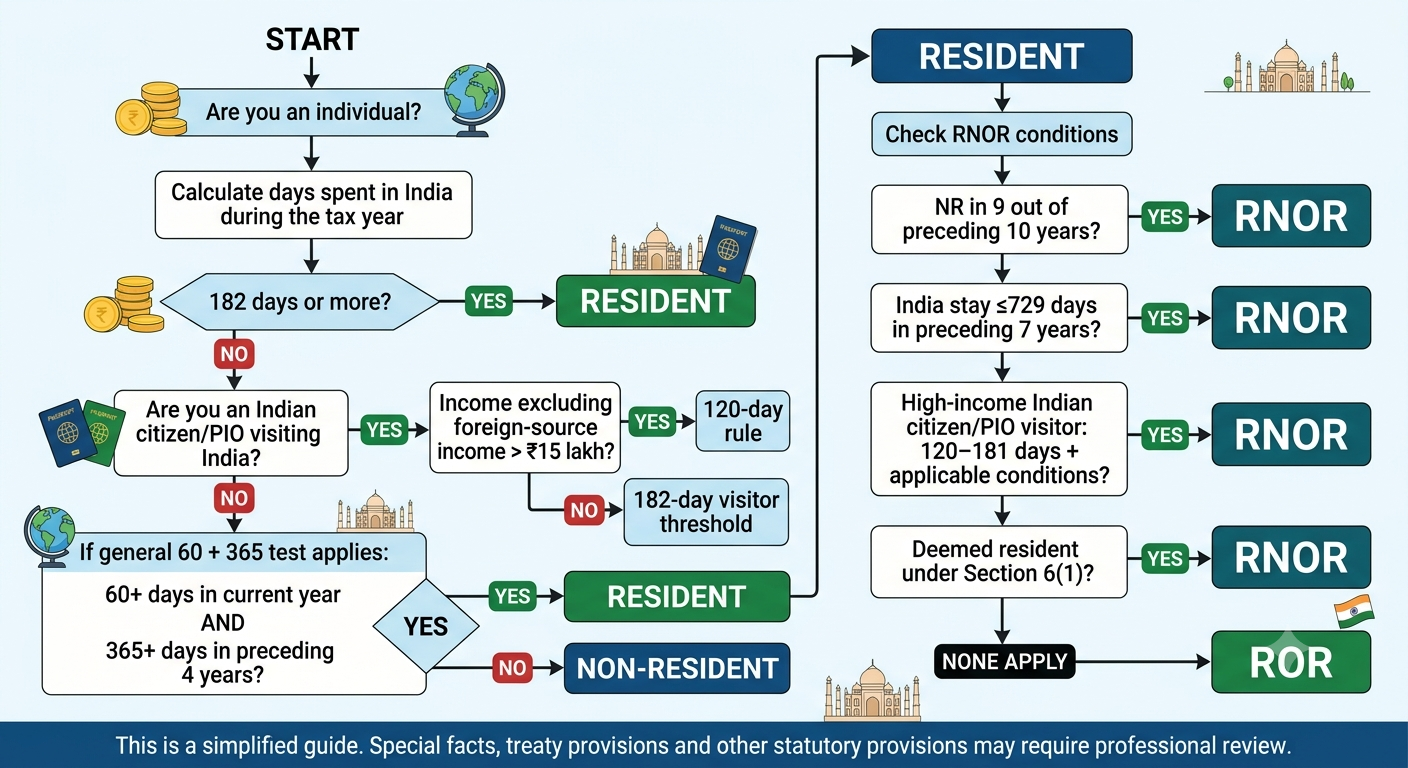
Eight Real-World Case Studies
Case Study 1 — NRI Visiting India for 90 Days
Facts:
Sameer lives in London. During Tax Year 2026–27, he spends 90 days in India. His Indian income excluding foreign-source income is ₹8 lakh. He has spent 420 days in India during the preceding four years.
Analysis:
Because Sameer is an Indian citizen/PIO visiting India and his relevant income does not exceed ₹15 lakh, the special 182-day visitor threshold applies.
He stayed only 90 days.
Result:
Generally Non-Resident.
Tax consequence:
Indian-source income remains taxable in accordance with Section 5 and other provisions. His UK salary is not generally taxable in India merely because he visited India.
Case Study 2 — NRI Visiting India for 150 Days With ₹20 Lakh Indian Income
Facts:
Aisha is an Indian citizen living in Singapore.
- India stay: 150 days
- Indian income excluding foreign-source income: ₹20 lakh
- Stay in preceding four years: 400 days
Analysis:
The ₹15 lakh threshold is crossed.
Therefore, the 120-day test applies.
150 days ≥ 120 days and preceding stay is 365+ days.
Result:
Aisha becomes Resident.
But because she falls within the special RNOR category for qualifying high-income visitors staying 120–181 days, she is generally RNOR.
Case Study 3 — Same Person, Only 119 Days
Facts are identical except Aisha stays in India for 119 days.
Since:
- 119 < 120; and
- assuming she does not satisfy another residence test,
she remains Non-Resident.
Lesson:
For a qualifying high-income Indian citizen/PIO visitor, the difference between 119 and 120 days can be significant.
Case Study 4 — Indian Citizen Leaving for Employment Abroad
Facts:
Rohan leaves India on 1 October 2026 to take up employment in Germany.
His India stay during Tax Year 2026–27 is 165 days.
Analysis:
Because he left India for employment outside India, the special employment rule applies.
The ordinary 60-day + 365-day test is replaced by the special 182-day framework.
Result:
Generally Non-Resident, assuming no other provision applies.
Case Study 5 — Returning Indian
Facts:
Neha has lived in Canada for eight years. She returns permanently to India in July 2026.
She spends 270 days in India during Tax Year 2026–27.
Result:
She is clearly resident because she exceeds 182 days.
However, she may qualify as RNOR because of her previous non-resident history.
Tax impact:
This can be extremely important because qualifying foreign income may not immediately become taxable in India in the same way as it would for an ROR.
Case Study 6 — Deemed Resident
Facts:
Arjun is an Indian citizen.
He lives in a jurisdiction where he is not liable to tax because he does not satisfy the jurisdiction’s residence criteria.
His income other than foreign-source income exceeds ₹15 lakh.
He spends only 30 days in India.
Analysis:
The normal day-count tests may not make him resident.
However, Section 6(7) can deem him resident if all statutory conditions are satisfied.
Result:
Deemed Resident and therefore RNOR.
Case Study 7 — Returning NRI Becomes ROR
Facts:
Vikram returns to India after a long overseas career.
He becomes resident in India in Tax Year 2026–27.
However, he has also been resident in India in several of the preceding years and has accumulated more than 729 days in India during the preceding seven years.
Analysis:
The RNOR conditions must be tested.
If neither the nine-out-of-ten test nor the 729-day test nor any special RNOR category applies:
Result: ROR.
Tax consequence:
His worldwide income generally becomes taxable in India, subject to the Act, exemptions and treaty relief.
Case Study 8 — RNOR With Foreign Business
Facts:
Zaid becomes RNOR after returning to India.
His Dubai business earns ₹1 crore.
The Dubai business is genuinely managed and controlled from Dubai.
Result:
The foreign business income will generally not become taxable merely because Zaid is RNOR.
But if the facts show that the business is actually controlled from India, the RNOR protection may not apply.
Lesson:
For RNORs, the words “business controlled in India” are extremely important.
Important Court Cases and Judicial Precedents
1. CIT v. Morgenstern Werner
Court: Supreme Court of India- Judgement Text
Year: 2002
Citation: 259 ITR 486 (SC); (2003) 11 SCC 445
The Supreme Court considered the residential-status consequences of an individual working in Germany who was found to be not ordinarily resident in India.
The Court noted that the assessee was a technician working in Germany and receiving salary there. The Supreme Court dismissed the Revenue’s appeal after accepting the factual findings concerning his residential status and taxability.
Why it matters:
It illustrates the importance of establishing residential status before determining the scope of taxable income.
2. CIT v. Suresh Nanda
Court: Delhi High Court- Judgement Text
Citation: (2013) 352 ITR 611 (Delhi)
The case concerned whether the assessee’s residential status could be determined by looking beyond the statutory day-count framework.
The judicial reasoning emphasised that Section 6 determines residential status primarily through the statutory tests concerning presence in India.
Why it matters:
The case is particularly useful for the principle that residential status is not simply determined by citizenship, permanent home or economic connections; the statutory residence test must be applied.
The decision has subsequently been discussed in cases concerning NRI status and the day-count test.
3. Jayram Rajgopal Poduval v. ACIT
Forum: ITAT Mumbai- Judgement Text
Year: 2008
The case concerned whether the assessee should be classified as ROR or RNOR.
The Tribunal examined the language of the RNOR test and concluded that the two historical conditions operated alternatively because the statutory language used “or”, not “and”.
Principle:
Satisfying either relevant historical condition can result in RNOR status.
Why it matters:
This remains a useful illustration of how the RNOR test operates.
4. Abhay Pratap Singh Sengar v. ITO
Forum: ITAT Lucknow- Judgement Text
Year: 2006
The case dealt with the RNOR provisions and historical residence conditions.
The Tribunal considered the amendments made by Finance Act, 2003 and discussed how the historical tests should be applied.
Why it matters:
It demonstrates why the exact version of Section 6 applicable to the relevant year matters.
5. Suresh Nanda v. ACIT
Forum: ITAT Delhi
The Tribunal considered the statutory residence test and circumstances involving the assessee’s stay outside India.
The case is particularly useful for understanding the principle that the statutory number of days in India is central to determining residential status.
6. Raghav Agarwalla v. Income Tax Officer
Forum: ITAT Mumbai- Judgement Text
Decision: 21 October 2024
The case considered residential status in the context of an Indian citizen and the Section 6 framework.
It is useful for readers dealing with the relationship between the basic day-count test and the special provisions applicable to Indian citizens.
7. Binny Bansal, Singapore v. DCIT
Forum: ITAT Bengaluru- Judgement Text
Decision: 9 January 2026
This is particularly interesting for readers because it is a relatively recent decision discussing Section 6 and residential status.
The Tribunal examined the statutory residential-status provisions and their historical evolution.
Why it matters:
It demonstrates that residential-status disputes continue to turn on precise statutory interpretation and factual evidence regarding presence in India.
Common Mistakes While Determining Residential Status
1. Assuming citizenship determines residence
It does not.
An Indian citizen can be a non-resident.
A foreign citizen can become an Indian resident.
2. Counting only the current year’s stay
The 60 + 365 test requires examination of the preceding four tax years.
3. Assuming 181 days always means NR
Wrong.
A person staying 181 days may still be resident under an applicable 60 + 365 or 120 + 365 test.
4. Assuming 182 days always means ROR
Wrong.
182 days can make a person resident, but the person may still be RNOR depending on the historical tests.
5. Ignoring the ₹15 lakh threshold
This can be particularly dangerous for high-income Indian citizens and PIO visitors.
6. Confusing FEMA residency with income-tax residency
The two laws have different objectives and tests.
7. Ignoring deemed residence
A person spending very little time in India may still be deemed resident if Section 6(7) applies.
8. Treating foreign income as automatically exempt
The tax treatment depends on residential status and the source/receipt/deeming provisions.
9. Ignoring business control
An RNOR with a foreign business must carefully establish where that business is actually controlled.
10. Using the wrong Act
For Tax Year 2026–27 onwards, use the Income-tax Act, 2025.
For FY 2025–26/AY 2026–27 and earlier relevant years, the Income-tax Act, 1961 remains relevant.
The transition depends on the tax year involved, not merely when the assessment happens.
Frequently Asked Questions (FAQs)
1. What is Section 6 of the Income-tax Act?
Section 6 of the Income-tax Act, 2025 deals with residence in India and determines whether a person is resident, RNOR or non-resident for Indian income-tax purposes.
2. How is residential status determined in India?
For an individual, residential status is primarily determined using the number of days spent in India, along with special rules for Indian citizens, PIOs, persons leaving India for employment and deemed residents.
3. Is 182 days mandatory to become a resident?
No. Under the general rule, an individual can also become resident through the 60 days + 365 days test.
4. What is the 120-day rule in India?
For qualifying Indian citizens/PIOs visiting India who have income excluding foreign-source income exceeding ₹15 lakh, the 60-day threshold is replaced with 120 days, subject to the statutory conditions.
5. Who is an RNOR in India?
An RNOR is a resident who satisfies one of the statutory conditions relating to residence in earlier years, including being non-resident in 9 out of 10 preceding tax years or having stayed in India for 729 days or less in the preceding seven tax years.
6. What is deemed residency?
Under Section 6(7), certain Indian citizens with more than ₹15 lakh of income other than foreign-source income who are not liable to tax in another country due to domicile, residence or similar criteria can be deemed resident.
7. Can an NRI become resident in India?
Yes. An NRI can become resident if the applicable Section 6 conditions are satisfied.
8. Does citizenship determine tax residency?
No. Citizenship and tax residency are separate concepts.
9. What is the difference between ROR and RNOR?
An ROR is generally taxable in India on worldwide income. An RNOR has a narrower tax exposure to foreign income, subject to the business-controlled-from-India and profession-set-up-in-India rules.
10. What is the difference between RNOR and NRI?
An RNOR is resident but not ordinarily resident. An NRI is generally a non-resident. The tax treatment of foreign income can differ significantly.
11. Does FEMA residential status determine income-tax residential status?
No. FEMA and income-tax law have separate definitions and tests.
12. How is foreign income taxed for an ROR?
Foreign income of an ROR is generally taxable in India, subject to exemptions, deductions, foreign-tax credit and applicable DTAA relief.
13. Is foreign income taxable for an RNOR?
Not automatically. Foreign income is generally included only in the circumstances specified in Section 5, including where it is derived from a business controlled in India or profession set up in India.
14. What happens when an NRI returns permanently to India?
The individual may become resident once the applicable Section 6 test is satisfied. However, the person may qualify as RNOR for a period depending upon their residence history.
15. How does DTAA affect residential status?
Domestic law first determines residence under Section 6. If another country also treats the person as resident, the applicable DTAA may contain treaty tie-breaker rules.
16. Can a person be resident under the Income-tax Act but non-resident under FEMA?
Yes. The two statutes apply different tests and serve different purposes.
17. What happens if I stay in India for exactly 182 days?
The individual satisfies the basic 182-day residence test, subject to the other provisions of Section 6.
18. What happens if I stay for exactly 120 days?
For a qualifying Indian citizen/PIO visitor with income exceeding ₹15 lakh and 365+ days of prior stay, 120 days can trigger residence. Such a person may be RNOR under Section 6(13).
19. What if I stay for 119 days?
The special 120-day test is not satisfied. However, all other applicable tests, including deemed residence, must still be examined.
20. Does the Income-tax Act, 2025 change the old residential-status rules?
The fundamental individual tests have largely been retained. The major change is the replacement and restructuring of the Income-tax Act, 1961 from 1 April 2026.
Quick Summary
The current Section 6 framework can be remembered as follows:
General rule
182 days or more → Resident
OR
60 days + 365 days in preceding four years → Resident
Indian citizen/PIO visitor
Special visitor rules apply.
High-income visitor
If income excluding foreign-source income exceeds ₹15 lakh:
120 days + 365 days → Resident
Deemed resident
Indian citizen + more than ₹15 lakh relevant income + not liable to tax elsewhere under the specified criteria:
Deemed Resident → RNOR
RNOR
Generally triggered where:
- NR in 9 of preceding 10 years; or
- 729 days or less in preceding 7 years;
with additional statutory categories for qualifying visitors and deemed residents.
ROR
Resident but none of the RNOR conditions apply.
Tax impact
ROR → worldwide income generally taxable
RNOR → Indian income + specified foreign income
NR → Indian-source/Indian-receipt income generally taxable
Sources & Further Reading
1. Income-tax Department — Section 6, Income-tax Act, 2025
Official Section 6 — Residence in India
2. Income Tax Department — Residential Status
Income Tax Department: Residential Status
3. Income Tax Department — NRI / Non-Resident FAQs under the Income-tax Act, 2025
Official NRI and Non-Resident FAQs
4. Income Tax Department — Transition from 1961 Act to 2025 Act
Official FAQs on Interplay and Transition
5. Income-tax Act, 1961 — Section 6
Section 6 of the Income-tax Act, 1961
6. Income-tax Act, 2025 — Section 5
Section 5 — Scope of Total Income
7. Tax Residency Certificate — Form 42
Income Tax Department Form 42 User Manual
8. Foreign Tax Credit / DTAA
Income Tax Department Form 41 — DTAA Relief
9. Foreign Assets and Foreign Income
Income Tax Department guidance on foreign assets and income disclosure
10. RBI — FEMA Residential Status
Legal Disclaimer
This article is intended only for general educational and informational purposes. It does not constitute legal, tax, financial or professional advice. Residential status can depend on detailed facts, travel history, income sources, foreign tax residence, FEMA provisions and applicable tax treaties. Readers should consult a qualified Chartered Accountant, tax practitioner or tax lawyer before taking a tax position or filing a return.