Receiving a notification from the Income Tax Department can instantly trigger anxiety. Tax filing has become largely automated, with Ai and data-matching algorithms scanning returns for discrepancies.
In 2026, tax authorities rely heavily on real-time data feeds from banks, stock exchanges, crypto platforms, and property registries. As a result, small oversights, hidden income, or unverified deduction claims can quickly trigger an automated notice.
Reviewing common filing errors can help prevent red flags and ensure compliance before submitting a return.
1. Mismatch Between Your Return and AIS/TIS Data
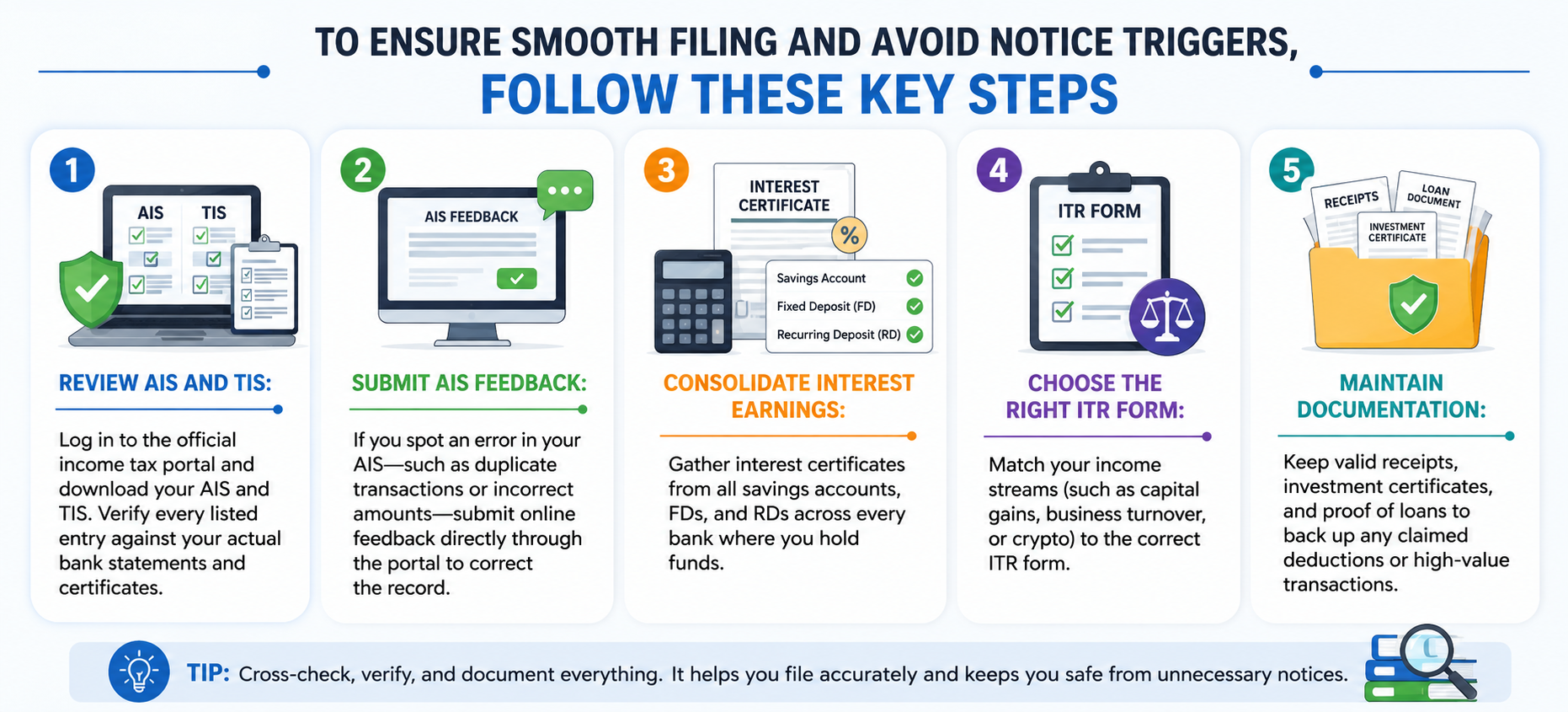
The Income Tax Department uses the Annual Information Statement (AIS) and Taxpayer Information Summary (TIS) as central financial ledgers for taxpayers. These statements compile details on salary, stock trades, mutual fund redemptions, dividend payouts, and interest income directly from financial institutions.
Automated systems flag accounts when reported numbers do not align with AIS records.
Real-Life Scenario:
Rohan changed jobs midway through the year. He relied solely on Form 16 from his current employer when filing his tax return. However, his AIS reflected income from both employers. Because Rohan failed to account for his previous earnings, the system flagged a major income mismatch, resulting in an automated notice for under-reported income.
2. Omitting Interest Income from Savings Accounts and FDs
A common misconception is that if a bank deducts Tax Deducted at Source (TDS) on a Fixed Deposit (FD) or Recurring Deposit (RD), no further action is required.
Banks generally deduct TDS at a standard rate of 10%. If an individual falls into a higher tax bracket (e.g., 20% or 30%), they must pay the remaining tax difference. Additionally, interest earned on savings accounts must be reported, even though Section 80TTA/80TTB offers deductions up to specified limits.
Real-Life Scenario:
Sunita holds multiple FDs across three different banks. Two of the banks deducted 10% TDS, while the third did not because the interest earned fell below the deduction threshold. Sunita assumed her tax obligations were satisfied and omitted the interest from her return. The tax portal consolidated all interest entries in her AIS, triggering an automated tax demand notice for the unpaid tax balance.
3. Ignoring Cryptocurrency and Virtual Digital Asset (VDA) Gains
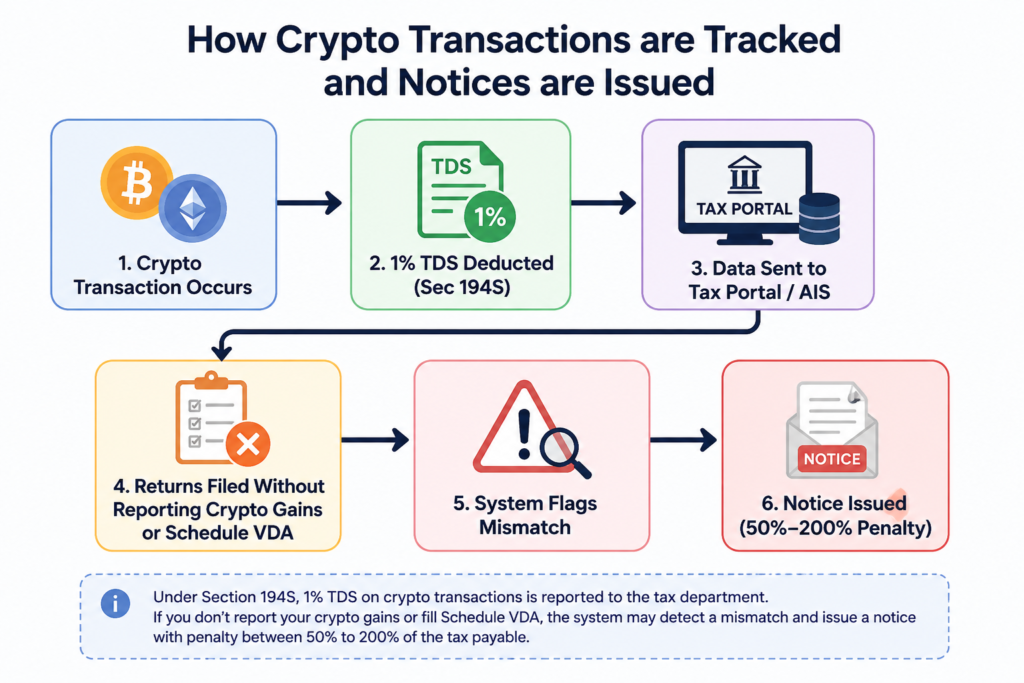
Tax authorities closely monitor cryptocurrency and Virtual Digital Asset (VDA) transactions. Under current regulations, crypto profits face a flat 30% tax rate, and losses in one asset cannot offset gains in another.
Indian crypto exchanges deduct 1% TDS under Section 194S on transactions, creating a direct trail sent to the tax department. Omitting crypto income or failing to complete the required Schedule VDA when filing can lead to non-compliance notices.

Real-Life Scenario:
Aarav made a net profit of ₹80,000 trading crypto on an Indian exchange. Thinking his small trading volume would go unnoticed, he filed using standard form ITR-1 without disclosing the profits. Because the exchange reported 1% TDS on his trades, the system flagged the missing Schedule VDA, resulting in a notice requiring him to pay tax, interest, and potential penalties.
4. Claiming Inflated or Unsupported Deductions
Claiming fake or exaggerated deductions under Chapter VI-A (such as Sections 80C, 80D, or 80G for donations) or claiming HRA without proper receipts is a major audit trigger. Data-driven monitoring tracks sudden, unexplained spikes in claimed deductions relative to income levels.
Real-Life Scenario:
Seeking a higher tax refund, Priya claimed ₹1.5 Lakh under Section 80C and ₹50,000 for medical insurance under Section 80D. However, she had only actually invested ₹30,000 in a Life Insurance Policy. The system flagged her unusually high refund request, and she received a notice asking for proof of investment, rent receipts, and bank statements. Failing to produce valid documents can result in disallowed claims and penalties for misreporting.
5. High-Value Financial Transactions Disconnected from Declared Income
Banks, credit card companies, property registrars, and stock brokers report high-value financial activities through the Statement of Financial Transactions (SFT).
The system flags profiles when annual financial transactions significantly exceed total declared income.
| Transaction Type | SFT Reporting Threshold |
|---|---|
| Credit Card Payments | Cash payments ≥ ₹1 Lakh; Other payment modes ≥ ₹10 Lakhs |
| Cash Deposits / Fixed Deposits (FDs) | Aggregate deposits ≥ ₹10 Lakhs in savings accounts or FDs |
| Property Purchase / Sale | Immovable property valued at ≥ ₹30 Lakhs |
| Investments | Mutual Funds, Stocks, or Debentures worth ≥ ₹10 Lakhs |
Real-Life Scenario:
Vikram declared an annual income of ₹6 Lakhs. During the same fiscal year, he bought a plot of land for ₹45 Lakhs, financing part of it with a family loan. The property registrar reported the transaction under SFT. Because his declared income did not align with a ₹45 Lakh purchase, he received a notice requesting verification of the source of funds.
6. Changing Jobs and Claiming the Standard Deduction Twice
Switching employers within a single financial year often leads to reporting errors. Both the previous and new employers may apply the standard deduction and basic exemption limits independently on their respective Form 16s.
If these figures are combined without adjustments during filing, the exemption is effectively claimed twice, creating a tax shortfall.
Real-Life Scenario:
Ananya switched jobs in August. Both employers provided a Form 16 applying the basic exemption limit and full standard deduction. Ananya simply added the tax-deducted figures together without recalculating her combined taxable income. This double-dip resulted in lower tax payments than required, triggering an automated demand notice.
7. Failing to Disclose Secondary Income (Freelancing, Capital Gains, Dividends)
All secondary earnings—including freelance income, rental yields, stock dividends, and capital gains—must be disclosed. Dividend payouts are reported by companies, while share and mutual fund sales are sent directly to your AIS by depositories and brokers.
Real-Life Scenario:
Kabir, a full-time software engineer, earned ₹1.2 Lakhs from freelance graphic design work and received ₹15,000 in stock dividends. He filed his return using only his employment Form 16. The tax portal cross-referenced the dividend distribution reports and bank credit entries, flagging his return for under-reporting secondary income.
8. Selecting the Wrong Tax Regime or Filing Form
Taxpayers can choose between the Old Tax Regime (which allows deductions) and the New Tax Regime (which features lower tax rates but fewer deductions). Choosing an incorrect ITR form or making conflicting selections can lead to a return being marked as defective under Section 139(9).
  Select Filing Form (ITR-1, ITR-2, ITR-3, ITR-4)
                         │
        ┌────────────────┴────────────────┐
        ▼                                 ▼
   Correct Form                    Incorrect Form
   (Processes Smoothly)       (Triggers Sec 139(9) Defective Return Notice)
ITR-1 (Sahaj): For resident individuals with income up to ₹50 Lakhs from Salary, One House Property, and Other Sources. Cannot be used if you have Capital Gains or VDA/Crypto income.
ITR-2: For individuals with capital gains, crypto assets, multiple house properties, or foreign assets, but no business profits.
ITR-3 / ITR-4: Designed for individuals earning income from a business or profession.
Real-Life Scenario:
Meera sold mutual fund units for a capital gain of ₹40,000. She filed using ITR-1 because her total income was under ₹50 Lakhs. Since ITR-1 does not support capital gains reporting, her return was flagged as structurally defective under Section 139(9).
9. Discrepancy Between Business Income and GST Returns
For freelancers, consultants, and business owners, the tax department cross-verifies turnover declared in Income Tax Returns with turnover reported in GST filings (GSTR-1 and GSTR-3B). Significant variations between these records can invite scrutiny.
Real-Life Scenario:
Dev runs a consulting firm. His annual GST returns reflected a total turnover of ₹80 Lakhs. However, in his ITR, he reported receipts of ₹55 Lakhs, attempting to adjust for unpaid invoices. The automated cross-matching system flagged the major turnover gap, leading to a scrutiny notice under Section 143(2).
10. Omitting Foreign Assets and Overseas Income
Resident individuals holding foreign bank accounts, overseas stock options (such as RSUs or ESOPs from multinational employers), or offshore investments are required to report them in Schedule FA (Foreign Assets).
Under the Black Money Act, failure to disclose foreign assets—even if they generate no taxable income—can carry steep penalties.
Real-Life Scenario:
Sneha received US stock options (RSUs) worth $3,000 from her employer’s parent company. She did not sell the shares or receive dividends, so she assumed no tax disclosure was necessary. Because she omitted the holdings from Schedule FA, she received a inquiry notice regarding undisclosed foreign assets.
How to Prevent Tax Notices