Income Tax Changes from April 2026: The Definitive Guide for Salaried Professionals (FY 2026–27)
As April 1, 2026 begins, salaried individuals in India face an important shift in the tax system. The new Tax Year 2026–27 is more than just a date change—it reflects India’s move toward a simpler tax structure with lower rates and fewer deductions under the Income Tax Act, 2025.
For today’s professionals, tax planning is no longer a last-minute task. It now involves smart cash-flow management, thoughtful investing, and staying compliant digitally. This guide will help you not just file your taxes correctly, but also plan better for your financial future.
1. Deconstructing the FY 2026–27 Framework
To master your taxes, you must first master the new terminology. The 2025 Act has abolished the “Financial Year” and “Assessment Year” labels to simplify the taxpayer experience.
The Unified Timeline
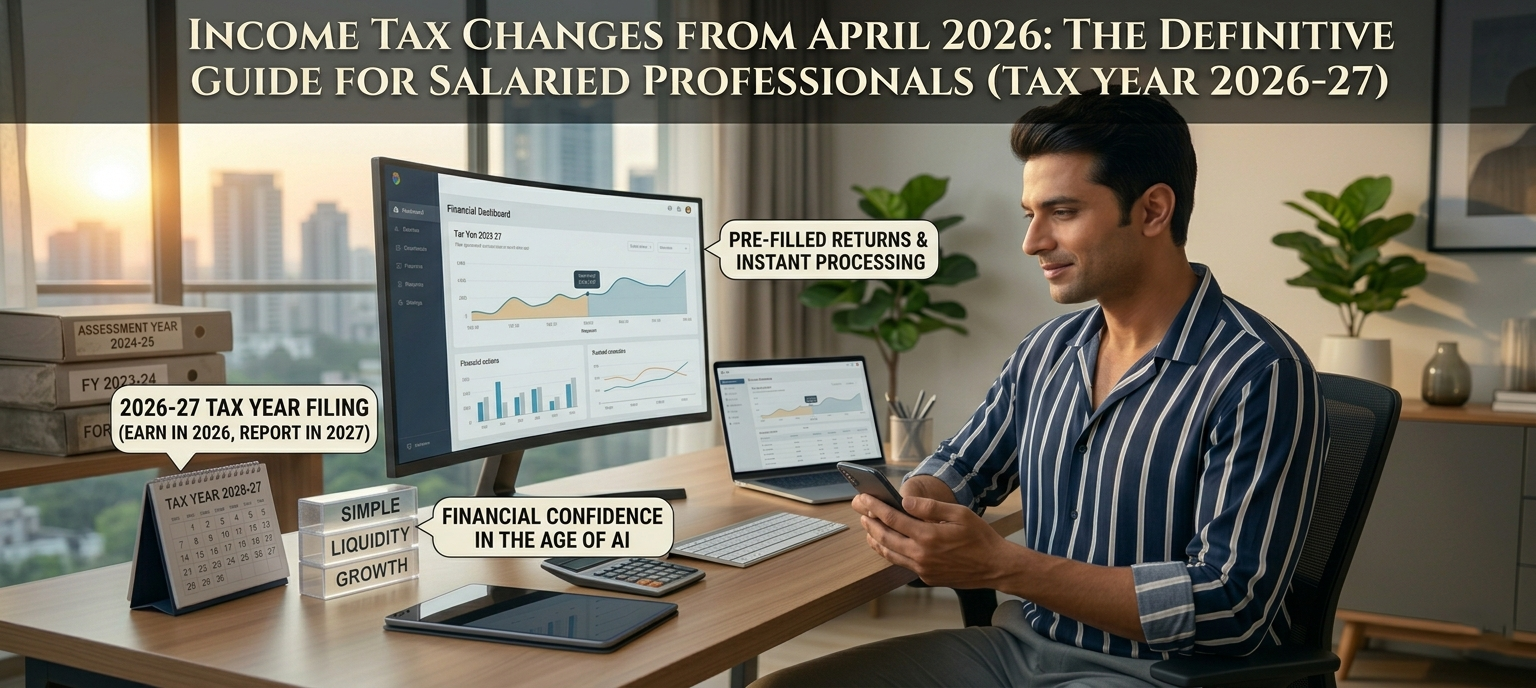
Tax Year 2026–27: This 12-month period (April 1, 2026 – March 31, 2027) is now the singular reference for both earning and reporting. Every rupee you earn during these months is subject to the rules of Tax Year 2026–27.
The Filing Cycle: While you still file your return after the earnings period (between April and July 2027), you will now simply refer to it as “Filing for Tax Year 2026–27.”
The “Early Bird” Strategic Advantage
The most significant mistake made by salaried individuals is treating tax planning as an end-of-year chore. By starting in April 2026:
1. Rupee Cost Averaging: Instead of dumping ₹1.5 lakh into an ELSS fund in March, you can invest ₹12,500 monthly, mitigating market volatility.
2. Accurate TDS Management: By declaring your regime to your HR department in April, your Tax Deducted at Source (TDS) is spread evenly across 12 months, preventing a “salary shock” in the final quarter.
3. Liquidity Planning: Understanding your tax liability early allows you to budget for big-ticket expenses like vacations or down payments without tax-induced cash crunches.
2. The Great Shift: Key Highlights for 2026
The 2026 tax landscape is defined by three pillars: The New Regime Default, Simplified Compliance, and Omniscient Monitoring.
The “Default” Trap
The New Tax Regime is now the established default. This is a subtle but powerful nudge by the government. If you join a new job or fail to submit a formal declaration to your employer, they are legally bound to calculate your TDS based on the New Tax Regime.
Critical Warning: For those with high home loan interest or massive Section 80C commitments, staying in the “Default” New Regime by accident can result in a significant drop in monthly take-home pay that cannot be recovered until you file your IFR a year later.
The End of “Tax Paperwork”
The move toward the New Tax Regime is a move toward a “frictionless” tax experience. The government’s intent is clear: they want to decouple tax-saving from investing. In the past, people bought poor-performing insurance policies just to save tax. By 2026, the system encourages you to invest because it’s a good financial move, not because you need a deduction.
The Rise of Digital Omniscience
The Income Tax Department’s “Project Insight” and AI-driven systems have matured. Your Annual Information Statement (AIS) is now a comprehensive financial diary. It tracks:
- High-value credit card settlements.
- Purchase of foreign currency for travel.
- Dividend income (even if not credited to your primary bank).
- Sale of fractional shares or crypto-assets.
In 2026, “omission” is often viewed as “evasion.” Transparency is your only shield.
3. Deciphering the Slabs: A Logic-Based Approach
Tax slabs are often viewed as rigid brackets, but they are actually a “progressive bucket” system.
The New Tax Regime: The Path of Least Resistance
The New Regime (under Section 115BAC) offers lower tax rates in exchange for giving up almost all exemptions (HRA, LTA, 80C, etc.).
Income Slab | Tax Rate |
Up to ₹3,00,000 | Nil |
₹3,00,001 – ₹6,00,000 | 5% |
₹6,00,001 – ₹9,00,000 | 10% |
₹9,00,001 – ₹12,00,000 | 15% |
₹12,00,001 – ₹15,00,000 | 20% |
Above ₹15,00,000 | 30% |
The Logic: This system is designed for the “Gig Economy” and the “Mobile Professional.” If you switch jobs frequently or live in a rented house that doesn’t provide high HRA benefits, the New Regime provides instant gratification through lower monthly TDS.
The Old Tax Regime: The “Saver’s Sanctuary”
The Old Regime remains for those who have structured their lives around long-term tax-saving instruments.
Income Slab | Tax Rate |
Up to ₹2,50,000 | Nil |
₹2,50,001 – ₹5,00,000 | 5% |
₹5,00,001 – ₹10,00,000 | 20% |
Above ₹10,00,000 | 30% |
The Logic: While the rates are higher, the “Taxable Income” is lower. If you earn ₹15 lakh but have ₹4 lakh in deductions, you are only taxed on ₹11 lakh.
4. The Strategic Comparison: Which One Wins?
The choice between regimes is not a one-size-fits-all answer. It is a mathematical “Breakeven Point” calculation.
The Breakeven Analysis
For most middle-income earners (₹10L – ₹15L), the Old Regime is better ONLY IF your total deductions (80C + 80D + HRA + Home Loan Interest) exceed approximately ₹3.75 lakh to ₹4.25 lakh.
- Choose the New Regime if: You prefer liquidity, you don’t have a home loan, and you find insurance/PPF investments cumbersome.
- Choose the Old Regime if: You are paying off a home loan (Section 24b), have high rent in a metro city (HRA), and max out your PF and Mediclaim.
The Psychological Component
The New Regime promotes Consumption. The Old Regime promotes Capital Formation. Ask yourself: If I don’t “force” myself to save for tax deductions, will I actually invest that extra money, or will I spend it on lifestyle upgrades?
5. Advanced Salary Scenarios
Let’s look at how the numbers play out in the real world for FY 2026–27.
Case A: The Entry-Level Associate (Salary: ₹7.5 Lakh)
- New Regime: Thanks to the Section 87A rebate, the tax is essentially Zero.
- Old Regime: Even with 80C, some tax might accrue due to the lower rebate threshold.
- Verdict: New Regime is the undisputed king for this bracket.
Case B: The Mid-Level Manager (Salary: ₹18 Lakh)
- Scenario 1 (No Home Loan): New Regime tax is roughly ₹2 lakh.
- Scenario 2 (Home Loan + Metro Rent): Old Regime tax could drop to ₹1.6 lakh if deductions are maximized.
- Verdict: The Old Regime remains powerful for the “Sandwich Generation” (those supporting parents and paying off a home).
6. The Standard Deduction: A Universal Gift
For FY 2026–27, the Standard Deduction remains a vital tool for salaried employees. It is a flat deduction (currently ₹50,000, though subject to Budget 2026 updates) that requires zero proof.
- Why it exists: To compensate salaried individuals for the “cost of earning” (commuting, professional attire, etc.) which business owners can claim as expenses.
- The 2026 Context: The government has integrated this into the New Tax Regime as well, making the New Regime even more attractive than it was at its inception.
7. Section 87A Rebate: The "Zero Tax" Magic
Section 87A is the reason why millions of Indians pay no tax despite earning well above the basic exemption limit.
- The Rule: If your total taxable income is below a certain threshold (₹7 lakh for the New Regime), you get a rebate that wipes out your tax liability.
- The Strategy: If your income is ₹7,20,000, you are not eligible for the rebate and will pay tax on the full amount above ₹3 lakh. However, by contributing to the NPS (National Pension System) or using other small deductions (in the Old Regime), you can pull your income below the threshold to pay Zero Tax.
8. The "Lost" Deductions: What You Give Up in the New Regime
Before you commit to the New Regime in April 2026, realize what you are leaving on the table. You cannot claim:
- Section 80C: No benefit for EPF, PPF, ELSS, or Children’s Tuition Fees.
- Section 24(b): No deduction for interest on a self-occupied property.
- HRA (House Rent Allowance): This is often the biggest loss for employees in Mumbai, Delhi, or Bangalore.
- Chapter VI-A: No 80D (Health Insurance) or 80G (Donations).
Strategic Insight: If you have an existing 20-year home loan, switching to the New Regime might be a financial disaster. Calculate the “Net Present Value” of your tax savings over the life of the loan before switching.
9. Impact on Take-Home Salary
The choice of regime changes your lifestyle throughout the year.
- New Regime = High Monthly Cash Flow: Your employer deducts less tax every month. This is great for those with high monthly SIPs or EMIs for personal growth (education loans).
- Old Regime = Year-End Liquidity: Often, people “over-invest” in March, leading to a cash crunch. However, the Old Regime forces a savings habit that builds a massive corpus over 20 years.
10. Common Mistakes to Avoid in FY 2026–27
1. The “Last-Minute” Declaration: Many employees miss the April deadline to declare their regime to HR. While you can change the regime when filing your return, you cannot get back the monthly liquidity lost to excess TDS during the year.
2. Ignoring the TIS/AIS: Always download your Taxpayer Information Summary before filing. If your AIS shows a ₹50,000 dividend you didn’t know about, the AI at the IT department will flag your return automatically.
3. Mixing Investment with Insurance: Buying “Money Back” policies for tax saving is the worst financial move. In 2026, buy Term Insurance for protection and use the New Regime to save tax.
4. Incorrect HRA Documentation: The department is now cross-referencing the PAN of landlords with their reported rental income. “Fake” rent receipts are a high-risk activity in the age of digital tracking.
11. Smart Tax Planning Strategies for the Modern Employee
The Hybrid Approach
Even if you are in the New Regime, you should still invest in the EPF (Employee Provident Fund). While you don’t get a tax deduction for the contribution, the interest earned remains one of the most tax-efficient ways to build a retirement corpus in India.
The NPS Power Play
The National Pension System (NPS) offers an additional ₹50,000 deduction under Section 80CCD(1B) in the Old Regime. In 2026, this remains a top-tier strategy for those in the 30% tax bracket.
12. Salary Structuring: The Negotiator’s Edge
When discussing your CTC (Cost to Company) for Tax Year 2026–27, focus on “tax-neutral” components:
- Food Coupons/Meal Vouchers: Usually tax-exempt up to a limit.
- Skill Development Reimbursements: Books and certifications paid by the company are generally not taxed as perquisites.
- Company Leased Car: For high-income earners, this can be more tax-efficient than a car loan.
13. Documentation: The Digital Vault
In 2026, physical receipts are becoming obsolete, but digital evidence is vital. Maintain a folder for:
- Form 16: Your primary tax certificate.
- Form 26AS: To verify that the tax deducted by your employer has actually reached the government.
- Interest Certificates: From all bank accounts (Savings and FD).
14. The Future: AI and Real-Time Compliance
By the end of TY 2026–27, the Income Tax Department aims for “Faceless Assessment 2.0.”
- Instant Processing: Many returns are now processed within 24 hours.
- Pre-filled Returns: In the New Regime, your ITR will likely be 90% pre-filled. Your job will be to “verify” rather than “file.”
15. Who Should Be Extra Vigilant?
- The “Side-Hustler”: If you have a salary plus freelance income, you must pay Advance Tax in instalments (June, Sept, Dec, March). Waiting until July 2027 will result in heavy interest penalties under Section 234B/C.
- The Global Indian: If you hold RSUs (Restricted Stock Units) in a foreign company (e.g., US-based tech firms), you must disclose foreign assets in the FA Schedule of your ITR, regardless of your income level. Failure to do so carries a ₹10 lakh penalty under the Black Money Act.
16. Advanced Tips: Family Tax Planning
- Rent to Parents: If you live in your parents’ house, you can pay them rent and claim HRA. If they are in a lower tax bracket, the family saves net tax.
- Health Insurance for Parents: Paying for your parents’ medical insurance can give you an additional deduction of up to ₹50,000 (if they are senior citizens) in the Old Regime.
Conclusion: Taking Control of TY 2026–27
The Income Tax landscape of April 2026 is no longer a maze—it is a choice between two distinct philosophies.
The New Tax Regime offers the freedom of choice. It gives you your money today to spend or invest as you see fit. It is the regime of the future, reflecting a global trend toward flat, simple taxes.
The Old Tax Regime is a legacy system that rewards specific financial behaviors: buying a home, protecting your family with insurance, and saving for the long term. For many, it remains a mathematically superior choice, provided they are willing to deal with the paperwork.
Your Action Plan for April 2026:
- Run the numbers: Use an online calculator to compare your tax under both regimes based on your projected salary.
- Declare early: Inform your HR by April 15th to stabilize your take-home pay.
- Automate: If you choose the Old Regime, set up your SIPs and insurance premiums to trigger in the first week of every month.
- Monitor: Check your AIS every quarter to ensure there are no surprises.
By taking these steps, you transform tax from a “burden” into a “budgetary line item,” allowing you to focus on what truly matters: growing your career and your wealth in the vibrant Indian economy.
Frequently Asked Questions (FAQs)
Q1. Can I change my mind about the regime later?
Yes. Even if you tell your employer “New Regime” in April, you can switch to “Old Regime” when filing your return in July 2027 (and vice versa), provided you have the necessary proofs.
Q2. Is the ₹50,000 Standard Deduction available in both regimes?
Yes, as per the latest updates leading into 2026, the Standard Deduction is applied to both the Old and New Tax Regimes for salaried individuals.
Q3. Does the ₹7 lakh tax-free limit apply to the Old Regime?
No. The rebate under Section 87A that makes income up to ₹7 lakh tax-free is specifically enhanced for the New Tax Regime. In the Old Regime, the rebate typically applies to taxable income up to ₹5 lakh.
Q4. What happens if I forget to report my savings account interest?
The bank reports this to the IT department via SFT (Statement of Financial Transactions). It will appear in your AIS. If you don’t report it, you may receive an automated “intimation” or notice to pay the difference plus interest.
Q5. Can I claim HRA if I am paying rent to my spouse? Technically, the law does not explicitly forbid it, but the Income Tax Department views such transactions with high scrutiny. To avoid a notice, the relationship should be commercial: there must be a formal rent agreement, monthly bank transfers (no cash), and the spouse must declare that rent as “Income from House Property” in their own tax return.
Q6. What happens if I switch jobs mid-year? This is a common “tax trap.” Both employers might give you the benefit of the basic exemption limit and standard deduction, leading to lower TDS. When you consolidate your income at the end of the year, you might find you owe a large lump sum in taxes. Always share your “Form 12B” (details of previous income) with your new employer to ensure accurate tax deduction.
Q7. Is the interest earned on my EPF account taxable? If your annual contribution to the Employee Provident Fund (EPF) exceeds ₹2.5 lakh, the interest earned on the excess contribution is taxable as “Income from Other Sources.” This rule remains a critical consideration for high-income earners in FY 2026–27.
Q8. Can I claim a deduction for an Electric Vehicle (EV) loan? Section 80EEB, which provided a deduction of up to ₹1.5 lakh on interest paid for EV loans, was a sunset clause. Unless extended in the 2026 Budget, this deduction is generally not available for new loans taken after the initial cutoff. Always check the latest Finance Act for specific extension clauses.
Q9. How are “Leave Encashment” payments taxed upon retirement? For non-government salaried employees, leave encashment at the time of retirement is exempt up to a limit of ₹25 lakh (increased in recent years). Any amount received above this threshold is taxed according to your applicable slab rate.
Q10. Do I need to keep physical copies of my 80C investment receipts? While you don’t need to attach them to your ITR, you must retain digital or physical copies for at least 6 years. If your return is picked for “Scrutiny Assessment,” the Assessing Officer will require these documents to validate your claims.