
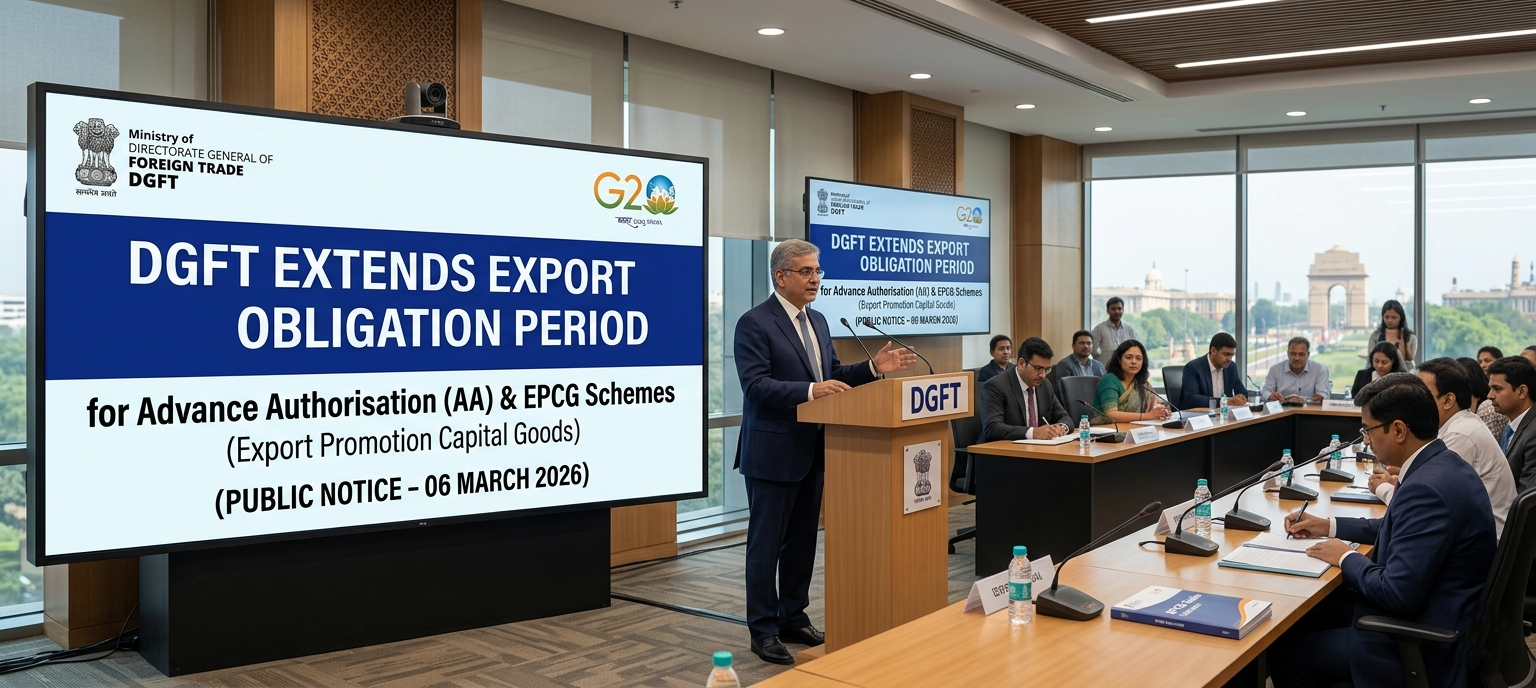
DGFT Extends Export Obligation Period for Advance Authorisation & EPCG Schemes
India’s export promotion framework provides several schemes that help exporters reduce import costs and enhance global competitiveness. One of the key compliance requirements under these schemes is the Export Obligation (EO)—the commitment to export goods within a specified time period after availing benefits such as duty-free imports or concessional duties.
To support exporters facing global trade disruptions, the Directorate General of Foreign Trade (DGFT) issued Public Notice No. 51/2025-26 dated 06 March 2026, extending the Export Obligation period for certain authorisations under the Advance Authorisation Scheme and the Export Promotion Capital Goods (EPCG) Scheme.
This article explains the notification in detail, including its background, scope, key provisions, and impact on exporters.
Background of the DGFT Notification
In recent years, global trade has been affected by several disruptions such as geopolitical tensions, logistics bottlenecks, and changes in shipping routes. These factors have increased transportation costs, delayed deliveries, and impacted export timelines.
Recognizing these challenges, the Government of India introduced a facilitation measure for exporters. Through Public Notice No. 51/2025-26, DGFT provided automatic extension of the Export Obligation period up to 31 August 2026 for certain authorisations.
The objective of this relaxation is to provide exporters additional time to meet export commitments without facing penalties or compliance issues.
Key Highlights of the Public Notice
The major provisions of the notification are summarized below:
1. Automatic Extension of Export Obligation
The Export Obligation period has been automatically extended until 31 August 2026.
This extension applies to authorisations where the original or already extended EO period was expiring between:
- 01 March 2026
- 31 May 2026
Exporters falling within this timeline will automatically receive the extension.
2. No Application Required
A key relief provided by the notification is that exporters do not need to submit any separate application to obtain this extension.
The extension is granted automatically, eliminating additional compliance procedures.
3. No Composition Fee
Normally, exporters seeking EO extensions must pay a composition fee under the Foreign Trade Policy.
However, under this public notice:
- No composition fee is required
- The extension is granted free of cost
4. Applicable Schemes
The relaxation applies to the following export promotion schemes:
- Advance Authorisation Scheme
- Advance Authorisation for Annual Requirement
- Special Advance Authorisation
- Export Promotion Capital Goods (EPCG) Scheme
These schemes are widely used by manufacturers and exporters across industries.
Official Link to the DGFT Public Notice
You can read the official government release here:
Understanding the Export Promotion Schemes
To understand the impact of the notification, it is important to briefly review the schemes covered.
1. Advance Authorisation Scheme
The Advance Authorisation Scheme allows exporters to import raw materials without payment of customs duty if those inputs are used for manufacturing export products.
Key features include:
- Duty-free import of inputs
- Mandatory export of finished goods
- Export Obligation within a specified period
This scheme helps exporters reduce production costs and improve international competitiveness.
2. EPCG Scheme (Export Promotion Capital Goods)
The EPCG Scheme allows import of capital goods (machinery or equipment) at zero or concessional customs duty, subject to fulfillment of export obligations.
Key features include:
- Duty benefits on capital goods imports
- Long-term export obligation
- Technology upgradation support
Both schemes play a major role in promoting export-oriented manufacturing in India.
Detailed Provisions of the DGFT Amendment
The public notice introduces specific changes to the Handbook of Procedures (HBP) under the Foreign Trade Policy (FTP) 2023.
1. Extension under Advance Authorisation
For all Advance Authorisations where the Export Obligation period expires between 1 March 2026 and 31 May 2026, the EO period is automatically extended up to 31 August 2026.
2. Extension under EPCG Scheme
For EPCG authorisations:
- Both block-wise export obligation and overall EO period expiring within the above period will also be extended to 31 August 2026.
3. Verification of Compliance
- Export obligation compliance will be verified by DGFT Regional Authorities at the time of:
- Issuance of Export Obligation Discharge Certificate (EODC)
- Closure of authorisation
- Regularisation of authorisation.
- Customs authorities will permit exports based on the revised timelines.
Important Conditions to Note
While the extension provides relief, exporters must keep certain conditions in mind.
1. Extension is Additional to Existing Provisions
The relaxation is in addition to existing extension provisions under the Handbook of Procedures.
2. No Refund of Composition Fee
If an exporter has already obtained an EO extension by paying a composition fee, the fee will not be refunded.
3. Compliance Must Still Be Fulfilled
The extension does not waive export obligation. Exporters must still fulfill the required export commitments.
Why the Government Introduced This Relief
The extension was introduced due to global trade disruptions affecting logistics and supply chains.
Some major factors include:
- Red Sea shipping disruptions
- Increased freight costs
- Longer transit times
- Global geopolitical tensions
- Supply chain instability
By extending the EO deadline, the government aims to ensure that exporters are not penalized for circumstances beyond their control.
Impact on Exporters and Industry
The notification is expected to have a positive impact on Indian exporters.
1. Compliance Relief
Exporters whose EO deadlines were approaching in early 2026 now get additional time to complete exports.
2. Financial Relief
Since no composition fee is required, exporters can avoid additional costs.
3. Operational Flexibility
Companies can better plan production and shipping schedules.
4. Support for Export Growth
The decision reflects the government’s commitment to supporting exporters and maintaining India’s export competitiveness.
Practical Example
Suppose a manufacturer imported raw materials under the Advance Authorisation Scheme and had an EO deadline of 15 April 2026.
Under the new public notice:
- The deadline automatically shifts to 31 August 2026
- No application is required
- No fee is payable
This gives the exporter over four additional months to fulfill export commitments.
Conclusion
The DGFT Public Notice dated 06 March 2026 providing extension of the Export Obligation period is a significant relief for exporters operating under the Advance Authorisation and EPCG schemes. By extending the EO deadline to 31 August 2026, the government has acknowledged the challenges faced by exporters due to global logistics disruptions.
The automatic nature of the extension—without application or composition fee—makes this measure particularly beneficial. Exporters should nevertheless ensure that they fulfill their export commitments within the revised timeline to obtain the Export Obligation Discharge Certificate (EODC) and remain compliant under the Foreign Trade Policy.
This step reinforces India’s policy direction of facilitating trade, supporting exporters, and strengthening global competitiveness.