


Introduction
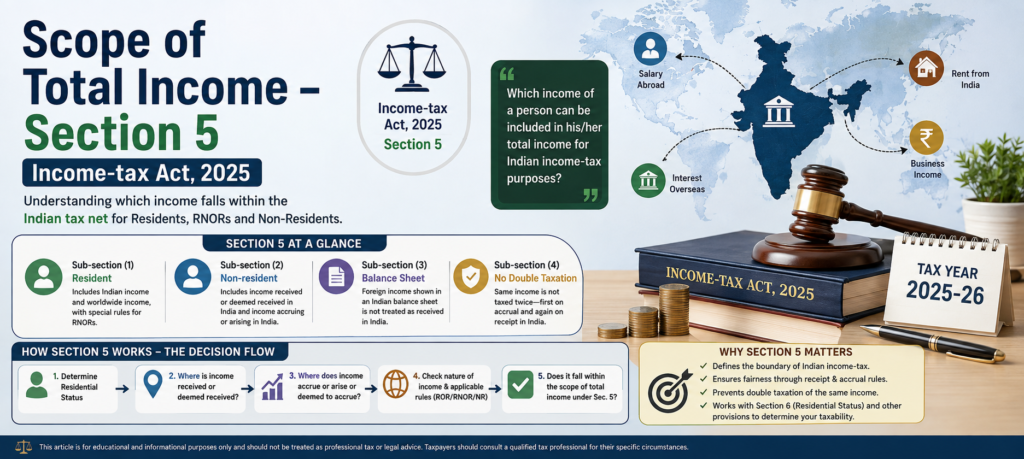
Imagine that the Income-tax Department has to answer one question before calculating the tax payable by a person:
“Which income of this person should come within the Indian income-tax net?”
That is essentially where Section 5 of the Income-tax Act, 2025 comes in.
Section 5 is titled “Scope of total income”. It does not itself calculate the final tax payable. Instead, it establishes the broad boundary of income that can enter the computation of a person’s total income for a tax year.
A useful way to remember it is:
Section 5 = deciding the boundary of the Indian income-tax net.
This becomes particularly important when a person has income connected with more than one country.
For example:
- An Indian resident works in Delhi and earns salary in India.
- The same person also earns interest from a US bank account.
- Another person works in Dubai but maintains investments and property in India.
- An Indian citizen returns to India for part of the year and becomes an RNOR.
- A non-resident receives rent from an apartment in Mumbai.
The answer will not be the same in all these cases.
The starting point is residential status, followed by the rules in Section 5 concerning receipt, accrual, deemed receipt and deemed accrual.
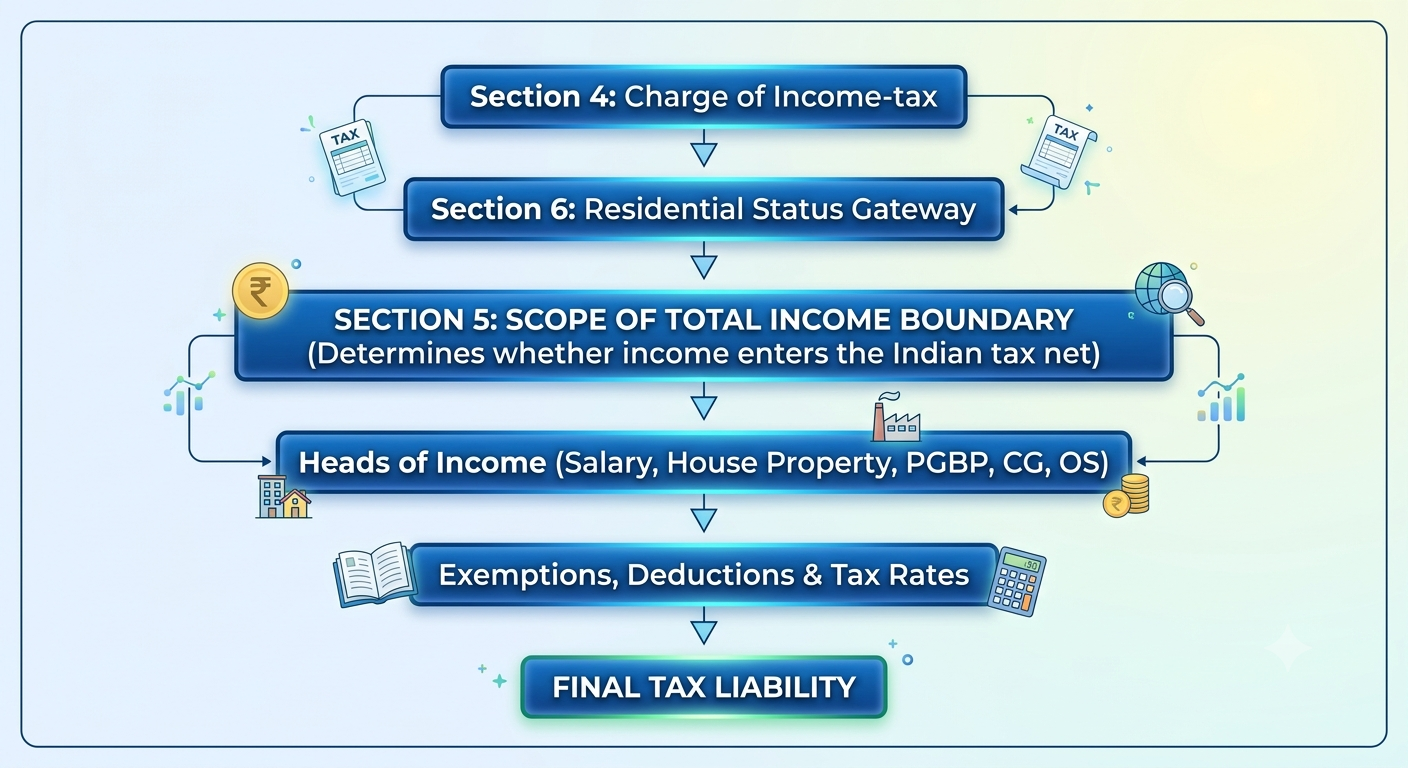
The broad sequence is:

What Does Section 5 Actually Do?
In simple terms, Section 5 answers:
Which income of a person can be included in his or her total income for Indian income-tax purposes?
The answer depends principally on two things:
- Who is the taxpayer from a residential-status perspective?
- Where was the income received or where did it accrue?
For a Resident and Ordinarily Resident (ROR), India generally adopts a worldwide-income approach.
For an RNOR, foreign income receives more limited treatment.
For a Non-Resident (NR), Section 5 generally brings into the Indian tax net income that is received in India or accrues/arises, or is deemed to accrue/arise, in India.
This is why Section 5 should never be read in isolation.
It works closely with:
- Section 4 – Charge of Income-tax
- Section 6 – Residence in India
- Section 7 – Income deemed to be received
- Section 9 – Income deemed to accrue or arise in India
- provisions dealing with heads of income, exemptions and deductions
- Section 159 – Double taxation relief
- Section 160 – unilateral relief where applicable
The current consolidated Act confirms this structure.
Section 5 – Exact Statutory Provision
The current Section 5 of the Income-tax Act, 2025 provides:
5. Scope of total income.
(1) Subject to the provisions of this Act, the total income of any tax year of a person, who is a resident, includes all income from whatever source derived, which—
(a) is received or deemed to be received in India in that year by or on behalf of such person;
(b) accrues or arises, or is deemed to accrue or arise, to such person in India in that year; or
(c) accrues or arises to such person outside India in that year, but when such person is “not ordinarily resident” in India under section 6(13), such income shall be included only when it is derived from a business controlled in or a profession set up in India.
(2) Subject to the provisions of this Act, the total income of a tax year of a person, who is a non-resident, includes all income from whatever source derived, which—
(a) is received or deemed to be received in India in that year by or on behalf of such person; or
(b) accrues or arises, or is deemed to accrue or arise, to such person in India in that year.
(3) Income accruing or arising outside India shall not be deemed to be received in India under this section by reason only of the fact that it is taken into account in a balance sheet prepared in India.
(4) If an income has been included in a person’s total income on the basis that it—
(a) has accrued or arisen; or
(b) is deemed to have accrued or arisen,
to such person, it shall not again be included on the basis that it is received or deemed to be received by that person in India.
Official reference: Income-tax Act, 2025 – consolidated text as amended by Finance Act, 2026
Section 5 Explained in Simple Language
The provision becomes much easier if we divide it into four questions.
Question 1: Are you a resident?
If yes, Section 5(1) applies.
Question 2: Are you a non-resident?
If yes, Section 5(2) applies.
Question 3: Where was the income received or where did it accrue?
The Act separately considers:
- receipt in India;
- accrual/arising in India;
- deemed receipt in India;
- deemed accrual/arising in India;
- accrual outside India.
Question 4: If the income arose outside India, are you ROR or RNOR?
This makes a major difference.
A simplified picture is:
Residential status | Indian income | Foreign income |
ROR | Generally, within Section 5 | Generally, within Section 5 |
RNOR | Generally, within Section 5 | Generally outside scope, unless covered by the business-controlled/profession-set-up-in-India rule or otherwise received/deemed received in India |
NR | Generally, within Section 5 | Generally outside scope unless received/deemed received in India or accrues/arises/deemed to accrue/arise in India |
The statutory wording is important because “foreign income” does not automatically mean “tax-free in India.”
Section 5(1): Scope for Residents
Section 5(1) deals with a person who is resident.
It contains three broad categories.
1. Income received or deemed to be received in India:
If income is received in India, it can fall within the total income of a resident.
The word “received” matters.
Suppose Rahul is a resident of India and earns ₹2 lakh interest from a foreign investment. If that income is actually received in India, the receipt limb of Section 5 can become relevant.
There are also statutory situations where income is deemed to be received.
For example, Section 7 specifically identifies certain incomes that are deemed to be received during the tax year.
Official reference: Section 7 – Income deemed to be received and dividend deemed to be income in a tax year.
2. Income accruing or arising in India:
Income does not have to be physically received in India to come within Section 5.
If income accrues or arises in India, it can be included.
This is particularly important where the taxpayer has earned income but payment has not yet actually been received.
For example:
A resident consultant completes work in India in March 2027 and becomes legally entitled to ₹3 lakh under the contract. The client pays the amount in April 2027.
The fact that the cash arrived later does not automatically shift the year in which the income accrued.
The Supreme Court has explained the distinction between receipt and accrual in several decisions. In E.D. Sassoon & Co. Ltd. v. CIT, the Court explained that income can accrue even without actual receipt where the taxpayer acquires a right to receive it.
3. Income accruing or arising outside India:
This is the part that makes Section 5 particularly important for international taxpayers.
For an ROR, foreign income is generally included.
For an RNOR, Section 5(1)(c) contains an important limitation.
Foreign income of an RNOR is included where it is derived from:
- a business controlled in India, or
- a profession set up in India.
So, an RNOR is not simply treated like an ROR for every item of foreign income.
Section 5(2): Scope for Non-Residents
Section 5(2) is considerably narrower.
For a non-resident, total income includes income that:
1. is received or deemed to be received in India, or
2. accrues/arises or is deemed to accrue/arise in India.
This is why the statement: “Non-residents do not pay Indian income tax” is incorrect.
A non-resident can certainly be taxable in India.
For example:
- rent from an Indian property;
- salary for services performed in India;
- interest covered by the deemed-accrual rules;
- royalty or fees for technical services falling within the statutory provisions;
- income attributable to an Indian business connection, subject to the detailed provisions.
The Income-tax Department’s 2026 guidance similarly explains that Section 5 limits a non-resident’s scope to income received/deemed received in India or accruing/arising/deemed to accrue/arise in India.
Section 5(3): Foreign Income Shown in an Indian Balance Sheet
This provision addresses a practical accounting situation.
Suppose a taxpayer has foreign income.
The taxpayer prepares accounts in India and includes the foreign income in an Indian balance sheet.
Does that accounting entry itself mean that the income has been received in India?
No.
Section 5(3) specifically says that foreign income does not become income received in India merely because it is taken into account in a balance sheet prepared in India.
Example:
A resident business has a bank account in the UK. It earns ₹5 lakh interest there.
The ₹5 lakh is recorded in the business’s Indian financial statements.
That accounting treatment, by itself, does not convert the foreign accrual into a receipt in India.
However, if the taxpayer is an ROR, the income may still be taxable because Section 5(1)(c) generally covers foreign income of an ROR.
So Section 5(3) does not say: “Foreign income shown in Indian accounts is tax-free.”
It says something narrower: Mere accounting in an Indian balance sheet does not, by itself, create a receipt in India.
Section 5(4): Preventing Double Inclusion
Section 5(4) is a simple but important anti-duplication rule.
Suppose income has already been included in total income because it:
- accrued/arose in India; or
- was deemed to accrue/arise in India.
Later, the same income is actually received in India.
Section 5(4) prevents the same income from being included again merely because it has subsequently been received.
Simple example
A company becomes legally entitled to ₹10 lakh on 31 March.
The income is included on the basis of accrual.
The company receives ₹10 lakh in its Indian bank account in April.
The ₹10 lakh is not taxed again merely because the cash was subsequently received.
This is one reason why understanding accrual is so important.
Receipt vs Accrual – What's the Difference?
This is one of the most important concepts under Section 5.
Receipt
Receipt broadly refers to the point at which income actually comes into the taxpayer’s hands or is received on the taxpayer’s behalf.
Accrual
Accrual is different.
Income can accrue when the taxpayer obtains a right to receive the income, even if actual payment takes place later.
The Supreme Court’s decision in E.D. Sassoon & Co. Ltd. v. CIT remains a classic authority on this distinction. The Court explained that a mere expectation is not enough; there must be a right to receive, involving a debt due to the taxpayer.
Think of it this way:
Work completed → right to receive arises → income accrues
Payment made later → income is received
These can happen in different tax periods.
Example
Meera completes professional services in March.
Under the contract, she becomes entitled to ₹1,00,000 on 31 March.
The client pays her on 15 April.
If the income has accrued in March, the subsequent April receipt does not automatically create another taxable item under Section 5.
That is precisely the type of duplication Section 5(4) prevents.
What Does “Deemed to be Received” Mean?
Sometimes the law treats an amount as received even though there has not been an ordinary cash receipt.
Section 7 contains statutory deeming rules.
For example, Section 7 provides rules for certain provident-fund accretions and specified employer contributions and also contains rules concerning dividends.
The important lesson is:
When Section 5 says “received or deemed to be received”, you cannot look only at actual bank credits. You must also examine the statutory deeming provisions.
This is why Section 5 has to be read with Section 7.
What Does “Deemed to Accrue or Arise in India” Mean?
This is mainly dealt with through Section 9 – Income deemed to accrue or arise in India.
Section 9 provides several deeming rules.
For example, income arising directly or indirectly through or from:
- an asset or source of income in India;
- property in India;
- a business connection in India; or
- transfer of a capital asset situated in India
can be deemed to accrue or arise in India, subject to the detailed statutory provisions.
Section 9 also contains specific rules for:
- salary;
- interest;
- royalty;
- fees for technical services;
- certain other specified income.
For instance, salary for services rendered in India is covered by the statutory deemed-accrual rule.
Therefore:
Section 5 tells us that deemed Indian accrual can enter total income; Section 9 tells us when income is deemed to accrue or arise in India.
ROR vs RNOR vs Non-Resident
Residential status is the gateway to applying Section 5.
Section 6 determines residential status for the purposes of the Act. It provides rules for individuals, HUFs, companies and other persons.
For individuals, the basic residence tests include the 182-day rule and the 60-day-plus-365-day rule, subject to specific exceptions. Section 6 also contains special rules for deemed residents and RNOR classification.
Comparison
Residential Status | Indian income | Foreign income | Foreign business controlled from India / profession set up in India |
Resident & Ordinarily Resident (ROR) | Generally taxable within scope | Generally included | Included as foreign income |
Resident but Not Ordinarily Resident (RNOR) | Generally taxable within scope | Generally outside scope | Foreign income is included where derived from a business controlled in India or profession set up in India |
Non-Resident (NR) | Generally taxable if received/deemed received or accrued/deemed accrued in India | Generally outside scope | Not a separate RNOR rule; Indian nexus must otherwise exist under Section 5(2)/Section 9 |
The RNOR rules in Section 6 include, among other things, the tests concerning non-residence in 9 out of 10 preceding tax years or presence in India for 729 days or less in the preceding seven tax years, together with special provisions for certain Indian citizens/persons of Indian origin and deemed residents.
Why this matters
The same ₹10 lakh of foreign interest can have different Indian tax consequences depending upon whether the recipient is:
- ROR;
- RNOR; or
- NR.
That is why starting the analysis with citizenship rather than residential status can lead to the wrong conclusion.
How Section 5 Works With Section 6
A useful way to remember the relationship is:
Section 6 tells you “who you are” for residence purposes. Section 5 tells you “what income comes within your total income”.
For example:
Person A
Resident and ordinarily resident.
Foreign bank interest: ₹2 lakh.
Result: Foreign income is generally within the scope under Section 5(1)(c).
Person B
RNOR.
Foreign bank interest: ₹2 lakh.
The interest is earned and first received outside India and is not connected with a business controlled in India or profession set up in India.
Result: Generally outside the scope under Section 5(1)(c), assuming no other Indian receipt/deemed-accrual rule applies.
Person C
Non-resident.
Foreign bank interest: ₹2 lakh.
It is earned and received outside India and has no Indian nexus.
Result: Generally outside Section 5(2).
This simple comparison shows why residential status is so important.
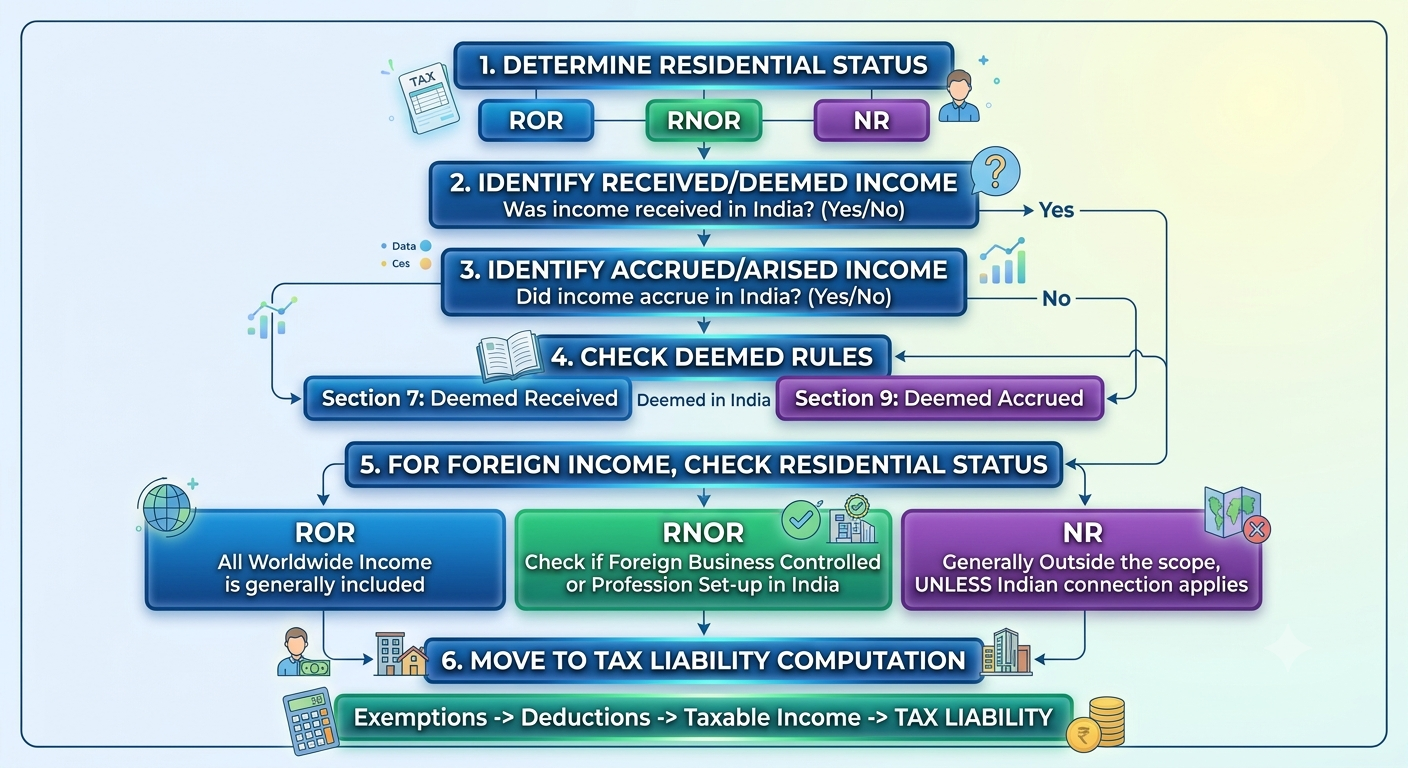
Decision Tree: How to Apply Section 5
Use the following practical decision tree.
12 Real-Life Examples and Case Studies
The following examples are hypothetical and are intended to illustrate the operation of Section 5.
Case Study 1 – Resident Employee in Delhi
Facts:
Aman is ROR and works for an Indian company in Delhi. He earns ₹8 lakh salary.
Residential status: ROR.
Source/location: Employment services performed in India.
Section 5 analysis: The income is Indian income and falls within the scope of total income.
Taxability: Within the broad scope of Section 5.
Conclusion: Aman cannot exclude the salary merely because he has not yet withdrawn it from his salary account.
Case Study 2 – Indian Bank Interest
Facts:
Sara, an ROR, has ₹40,000 interest from an Indian bank.
Residential status: ROR.
Source: Indian bank.
Section 5 analysis: Income received/accruing in India falls within Section 5.
Conclusion: The interest enters the broad computation of total income, subject to the other provisions governing computation and deductions.
Case Study 3 – ROR With US Bank Interest
Facts:
Rohit is ROR. He earns ₹1 lakh interest from a US bank and receives it in his US account.
Residential status: ROR.
Location: Foreign.
Section 5 analysis: Section 5(1)(c) covers foreign income of a resident. The RNOR restriction does not apply because Rohit is ROR.
Conclusion: The foreign interest is generally included in his Indian total income.
If US tax has also been paid, the separate double-taxation relief provisions may become relevant.
Case Study 4 – RNOR With Foreign Salary
Facts:
Zoya is RNOR. She works for a foreign employer and performs all services in the UK. Her salary is paid into her UK bank account.
Residential status: RNOR.
Location: Foreign.
Section 5 analysis: The salary accrues outside India. It is not derived from a business controlled in India or a profession set up in India.
Conclusion: Assuming there is no Indian receipt/deemed-accrual rule applicable, the salary is generally outside the scope under Section 5.
Important: If the salary had first been received in India, the receipt limb of Section 5 would need to be examined separately.
Case Study 5 – RNOR With Foreign Business Controlled From India
Facts:
Imran is RNOR. He owns a business operating in Dubai, but strategic control of the business is exercised from India.
Residential status: RNOR.
Income: Foreign business profits.
Section 5 analysis: Section 5(1)(c) specifically includes foreign income of an RNOR where it is derived from a business controlled in India.
Conclusion: The foreign income can come within Indian total income.
This is why “I am an RNOR, therefore my foreign income is never taxable” is incorrect.
Case Study 6 – Non-Resident Performing Services in India
Facts:
A UK-resident consultant spends three months in India providing consulting services to an Indian customer.
Residential status: NR.
Location of services: India.
Section 5 analysis: Section 5(2) covers income accruing/arising or deemed to accrue/arise in India. Section 9 contains the detailed deeming provisions.
Conclusion: Indian taxability must be examined; non-resident status by itself does not remove Indian tax exposure.
Case Study 7 – Non-Resident Renting Out Mumbai Property
Facts:
Neha lives permanently in Canada and is an NR for Indian tax purposes. She owns an apartment in Mumbai and earns ₹6 lakh rent.
Residential status: NR.
Location/source: Indian property.
Section 5 analysis: Section 9 contains a rule for income arising through property in India to be deemed to accrue/arise in India.
Conclusion: The rental income falls within the Indian tax net, subject to computation and other applicable provisions.
Case Study 8 – Non-Resident Indian Investment Interest
Facts:
Raj is NR and earns interest on an Indian investment.
Residential status: NR.
Source: Indian investment.
Section 5 analysis: Section 5(2) covers income accruing/arising or deemed to accrue/arise in India. The detailed Section 9 provisions must then be examined.
Conclusion: NR status does not prevent taxation of Indian-source interest.
Case Study 9 – ROR Selling Foreign Shares
Facts:
A resident ROR individual sells shares of a US company and earns a capital gain of ₹4 lakh.
Residential status: ROR.
Location: Foreign company/shares.
Section 5 analysis: For an ROR, foreign income is generally within the scope of total income.
Conclusion: The foreign capital gain generally enters the Indian tax computation, subject to the detailed capital-gains provisions and any applicable treaty relief.
Case Study 10 – Foreign Income Only Recorded in Indian Books
Facts:
An Indian business earns ₹5 lakh interest in a foreign bank account. The amount remains abroad but is recorded in its Indian balance sheet.
Section 5 analysis: Section 5(3) says that merely taking foreign income into account in a balance sheet prepared in India does not make it income received in India.
Conclusion: The accounting entry itself does not create an Indian receipt.
However, if the taxpayer is an ROR, the foreign income may still be taxable under Section 5(1)(c).
Case Study 11 – Accrual Followed by Receipt
Facts:
A consultant becomes entitled to ₹3 lakh in March. The amount is included on accrual. The client pays ₹3 lakh in April.
Section 5 analysis: The income may be included when it accrues. Section 5(4) prevents the same income from being included again merely because it is later received in India.
Conclusion: No automatic second inclusion of the same income.
Case Study 12 – Person Moving Abroad During the Year
Facts:
Kabir works in India for several months and then moves to Singapore for employment. He earns income in both countries.
Residential status: Must be determined under Section 6 for the relevant tax year.
Section 5 analysis: The answer cannot be determined simply by asking where Kabir was living on 31 March.
His physical presence and the special rules under Section 6 must first be considered. Once his status is determined, Section 5 determines the broad scope of his income.
Conclusion: A person moving abroad during the year should not assume that all income earned after moving abroad is automatically outside Indian tax.
Important Judicial Decisions
Most of the important case law on receipt, accrual, territorial nexus and deemed accrual was decided under the Income-tax Act, 1961 or earlier legislation.
Those cases should not be described as decisions under the Income-tax Act, 2025.
However, where the corresponding principles have been carried into the 2025 Act, these judgments can remain useful interpretative authorities, subject to the exact statutory wording and later developments.
Case | Court / Year | Core issue | Principle | Relevance to Section 5 |
E.D. Sassoon & Co. Ltd. v. CIT | Supreme Court, 1954 | Meaning of accrual and receipt | Income can accrue when the taxpayer obtains a right to receive it; actual receipt may occur later | Important for Section 5’s distinction between accrual and receipt |
CIT v. R.D. Aggarwal & Co. | Supreme Court, 1965 | Business connection of non-resident | Business connection requires a real and intimate relationship between Indian activity and the non-resident’s business contributing to income | Relevant to Indian nexus and deemed accrual principles |
Carborundum Co. v. CIT | Supreme Court, 1977 | Operations of non-resident business | Taxability of non-resident income depends on the relevant operations/nexus in India | Useful for territorial nexus |
CIT v. Toshoku Ltd. | Supreme Court, 1980 | Foreign commission income of non-resident | Where relevant business operations giving rise to commission were outside India, the income was not automatically deemed to accrue in India merely because an Indian connection existed | Relevant to Section 5(2) read with Section 9 |
Ishikawajma-Harima Heavy Industries Ltd. v. DIT | Supreme Court, 2007 | Offshore/onshore components of non-resident contract | Territorial nexus and the location of operations are important in determining Indian taxability | Relevant to Indian accrual/deemed accrual |
U.A.E. Exchange Centre Ltd. v. Union of India | Supreme Court, 2020 | Activities of UAE company through Indian liaison offices | Examined whether activities in India created Indian taxable income under Sections 5 and 9 of the 1961 Act | Useful for understanding Indian nexus for non-residents |
1. E.D. Sassoon & Co. Ltd. v. CIT
This is one of the most important authorities for understanding accrual.
The Supreme Court explained that income can accrue even though actual payment occurs later, provided the taxpayer has acquired a right to receive it.
This is directly relevant to the distinction between Section 5’s receipt and accrual limbs.
2. CIT v. R.D. Aggarwal & Co.
The Supreme Court considered the concept of business connection.
The principle is useful because Section 9 of the 2025 Act contains detailed rules concerning income deemed to accrue or arise through business connection in India.
3. CIT v. Toshoku Ltd.
The Supreme Court dealt with commission income earned by non-residents and the question of whether it accrued or was deemed to accrue in India.
The decision illustrates an important point:
Merely having some commercial connection with India does not automatically mean that all foreign income becomes Indian income.
The detailed statutory test concerning the operations and Indian nexus remains critical.
4. Ishikawajma-Harima Heavy Industries Ltd. v. DIT
The case concerned a Japanese company and a large turnkey project involving offshore and onshore activities.
The Supreme Court examined the territorial nexus of different components of the income.
5. U.A.E. Exchange Centre Ltd. v. Union of India
The Supreme Court examined the Indian activities of a UAE company operating through liaison offices.
The judgment expressly considered Sections 5 and 9 of the 1961 Act and the question of whether income of a non-resident had an Indian nexus.
Important caution: These cases arose under the earlier statutory framework. Their principles may assist in interpreting corresponding concepts in the 2025 Act, but they should not be presented as rulings on Section 5 of the Income-tax Act, 2025 itself.
7 Common Misunderstandings About Section 5
1. “I am an Indian citizen, so all my worldwide income is automatically taxable in India.”
Wrong.
Citizenship and residential status are not interchangeable.
Section 6 determines residential status, and Section 5 then applies the relevant scope rules.
2. “Foreign income is always exempt for an RNOR.”
Wrong.
Foreign income of an RNOR can be included where it is derived from a business controlled in India or a profession set up in India.
Also, separate receipt or deemed-accrual rules must be checked.
3. “Non-residents never pay Indian tax.”
Wrong.
Indian-source income of a non-resident can be taxable in India.
4. “Income is taxable only when cash is received.”
Wrong.
Income can be taxable on accrual where the taxpayer has acquired the relevant right to receive it.
5. “If I show foreign income in my Indian balance sheet, I have received it in India.”
Wrong.
Section 5(3) specifically prevents this conclusion merely from the accounting entry.
6. “Section 5 tells me exactly how much tax I have to pay.”
Wrong.
Section 5 establishes scope.
Other provisions deal with computation, exemptions, deductions, tax rates, reliefs and collection.
7. “Section 5 and Section 6 are the same thing.”
Wrong.
Section 6 determines residential status.
Section 5 determines the scope of total income after taking that status into account.
Practical Section 5 Checklist for Taxpayers
Before deciding whether an item of income is taxable in India, ask:
☐ What is my residential status?
☐ Am I ROR, RNOR or NR?
☐ Where was the income first received?
☐ Was it received or deemed to be received in India?
☐ Where did the income accrue or arise?
☐ Could it be deemed to accrue or arise in India under Section 9?
☐ Is it foreign income?
☐ If I am RNOR, is it derived from a business controlled in India or a profession set up in India?
☐ Has the same income already been included on an accrual basis?
☐ Is there a DTAA with the relevant foreign country?
☐ Could foreign tax credit or other double-taxation relief be available?
☐ Are there exemptions or deductions under other provisions?
This checklist is particularly useful for people who:
- work overseas;
- have foreign bank accounts;
- receive foreign dividends;
- own foreign shares;
- operate businesses in multiple countries;
- move to or from India during the year;
- receive foreign salary or consultancy income.
How Section 5 Interacts With Double Taxation
Suppose an ROR earns income in the US and pays US tax.
Section 5 may still bring the foreign income within Indian total income.
Does that necessarily mean the taxpayer must economically pay the same tax twice?
Not necessarily.
The Income-tax Act, 2025 contains separate provisions dealing with double-taxation relief.
Section 159 permits the Central Government to enter into agreements with foreign countries or specified territories for, among other things, relief from double taxation. Where a notified agreement applies, the Act provides that its provisions can apply to the extent they are more beneficial to the assessee.
Section 160 separately provides for certain unilateral relief where the relevant foreign country does not have an agreement with India.
Therefore:
Scope under Section 5 and relief from double taxation are two different questions.
First ask:
Is the income within Indian tax scope?
Then ask:
Is relief available for foreign tax already paid?
Frequently Asked Questions (FAQs)
1. What is Section 5 of the Income-tax Act, 2025?
Section 5 defines the broad scope of total income. It determines which income of residents and non-residents enters the Indian tax computation.
2. Does Section 5 tax worldwide income?
For an ROR, Section 5 generally brings worldwide income within the scope, subject to the rest of the Act.
For RNORs and non-residents, the rules are narrower.
3. Is foreign income taxable in India for a resident?
For an ROR, generally yes.
For an RNOR, foreign income is subject to the specific limitation in Section 5(1)(c) and other applicable receipt/deemed-accrual rules.
4. Is foreign income taxable for an RNOR?
Not automatically.
Foreign income derived from a business controlled in India or a profession set up in India can be included. Foreign income first received in India can also require separate analysis.
5. Is foreign income taxable for a non-resident?
Generally, foreign income with no Indian receipt/accrual/deemed-accrual connection is outside Section 5(2).
6. What is the difference between receipt and accrual?
Receipt concerns actual or statutory receipt.
Accrual concerns the point at which the taxpayer obtains a right to receive the income.
The Supreme Court’s E.D. Sassoon decision is a leading authority on this distinction.
7. What does “deemed to accrue or arise in India” mean?
It means that the Act treats certain income as arising in India even if ordinary commercial analysis might place the income elsewhere. Section 9 contains these detailed deeming provisions.
8. Can the same income be taxed twice under Section 5?
Section 5(4) prevents the same income from being included again merely because it was first included on accrual and later received in India.
9. Does showing foreign income in an Indian balance sheet make it taxable in India?
Not merely because of that accounting entry. Section 5(3) specifically addresses this situation.
But an ROR may still be taxable on the foreign income under Section 5(1)(c).
10. How does Section 6 affect Section 5?
Section 6 determines residential status.
Section 5 then uses that residential classification to determine the scope of total income.
11. Has Section 5 been amended recently?
As of 29 August 2026, no direct amendment to Section 5 has been identified in the Finance Act, 2026. However, Finance Act 2026 amended other provisions, including Section 7, which can affect the practical operation of Section 5’s deemed-receipt limb.
12. Does Section 5 determine the final tax payable?
No.
It determines the broad scope of income.
The final tax calculation requires consideration of heads of income, exemptions, deductions, losses, rates, surcharge, cess, reliefs and other applicable provisions.
The Big Picture: Section 4, 5, 6, 7 and 9 Together
The easiest way to understand the architecture is:
Section 4
Why is tax charged?
Income-tax is charged on total income.
Section 5
What income comes within total income?
This is the scope question.
Section 6
What is the person’s residential status?
ROR, RNOR or NR.
Section 7
When does the law treat an amount as received?
It contains specified deemed-receipt rules.
Section 9
When does the law treat income as accruing/arising in India?
It contains the detailed deemed-accrual provisions.
Other provisions
How is the income computed and what tax is ultimately payable?
This includes heads of income, exemptions, deductions, reliefs and rates.
This structure prevents a common mistake: trying to determine taxability from Section 5 alone.
The Most Important Practical Lessons
If you remember only five things from this article, remember these:
1. Section 5 is about scope, not final tax calculation.
It decides which income enters the broad tax computation.
2. Residential status is crucial.
The same foreign income can have different consequences for an ROR, RNOR and NR.
3. Receipt and accrual are different.
Income may become taxable on accrual even before cash is received.
4. Section 5 must be read with Sections 6, 7 and 9.
Residential status, deemed receipt and deemed accrual can change the answer.
5. The 2025 Act has largely preserved the core Section 5 concept.
The major structural change is the new Act and its tax-year framework, rather than a fundamental reinvention of the territorial scope rules.
Conclusion
Section 5 of the Income-tax Act, 2025 is essentially the boundary-setting provision of Indian income taxation.
Before asking:
“How much tax do I have to pay?”
you first need to ask:
“Which of my income comes within the Indian tax net?”
Section 5 answers that question by looking at:
residential status + receipt + accrual + deemed receipt + deemed accrual + foreign-income rules.
For an ROR, the Indian tax net is generally wide enough to include foreign income.
For an RNOR, the net is narrower, particularly for foreign income that is neither received in India nor connected with a business controlled in India or profession set up in India.
For a non-resident, the focus is primarily on income received/deemed received in India or income accruing/arising/deemed to accrue/arise in India.
The most important practical point is that Section 5 should never be read as a standalone provision. Section 6 determines residential status; Section 7 deals with specified deemed receipts; Section 9 deals with deemed Indian accrual; and the double-taxation provisions can become relevant when the same foreign income is taxed abroad.
The Income-tax Act, 2025 therefore does not make the basic question obsolete. It makes the question even more important:
Before calculating tax, first determine the boundary of the income that India is entitled to tax.
Sources & Authorities
Official legislation and Government sources
- Income-tax Act, 2025 – Income Tax Department
- Section 5 – Scope of total income – Income Tax Department
- Income-tax Act, 2025 as amended by Finance Act, 2026 – official consolidated Act
- Finance Act, 2026 – official Government publication
- Income-tax Rules, 2026 – CBDT notification
- CBDT Transition FAQs on the Income-tax Act, 2025
Judicial authorities
- E.D. Sassoon & Co. Ltd. v. Commissioner of Income Tax, Bombay – Supreme Court, 1954 – accrual and right to receive income.
- Commissioner of Income Tax v. R.D. Aggarwal & Co. – Supreme Court, 1965 – business connection and Indian nexus.
- Carborundum Co. v. CIT – Supreme Court, 1977 – operations and territorial nexus.
- CIT v. Toshoku Ltd. – Supreme Court, 1980 – non-resident commission income and Indian accrual/deemed accrual.
- Ishikawajma-Harima Heavy Industries Ltd. v. DIT, Mumbai – Supreme Court, 2007 – offshore/onshore operations and territorial nexus.
- U.A.E. Exchange Centre v. Union of India – Supreme Court, 2020 – Sections 5 and 9 and Indian business connection.
Important legal note
The judicial decisions cited above were decided under the Income-tax Act, 1961 or earlier statutory frameworks, not under the Income-tax Act, 2025. They are cited only for principles concerning accrual, receipt, territorial nexus and deemed accrual that remain relevant to corresponding concepts under the new Act. They should not be represented as judgments interpreting Section 5 of the 2025 Act.
Disclaimer
This article is for educational and informational purposes only and should not be treated as professional tax or legal advice. Taxpayers should consult a qualified tax professional for their specific circumstances.